- 3.17mm (1/8 inch) is the dominant zinc wire diameter for both arc spray and flame spray and is compatible with most commercial gun models.
- Wire diameter directly affects deposition rate, coating surface roughness, and droplet size, all of which influence final coating quality.
- Equipment compatibility is the primary constraint: always match wire diameter to the gun manufacturer’s specification.
- Larger diameters deliver higher deposition rates; smaller diameters produce finer droplets and slightly smoother coating surfaces.
- Dimensional tolerance of plus or minus 0.05mm is the standard for 3.17mm zinc wire; out-of-tolerance wire causes inconsistent performance.
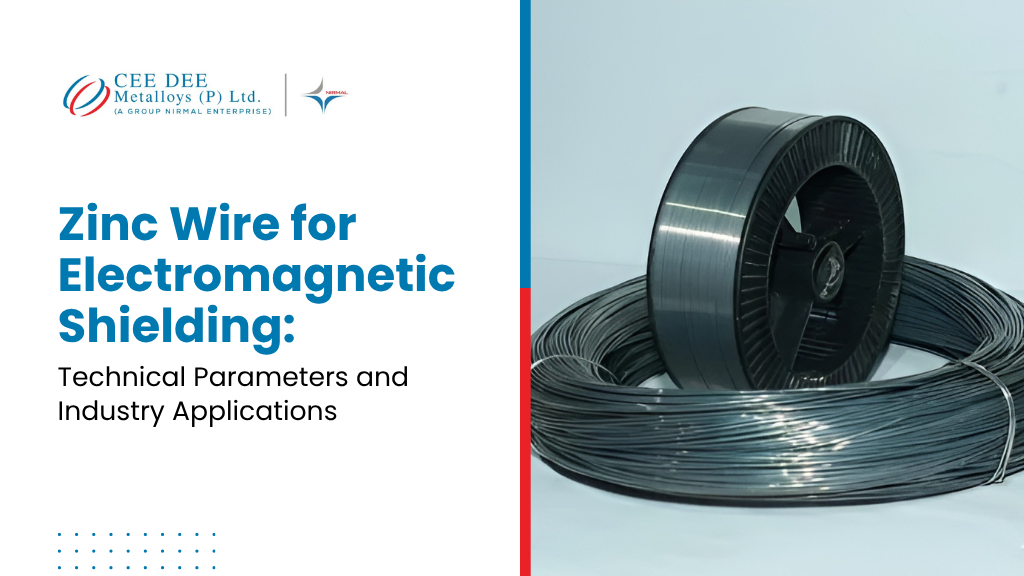
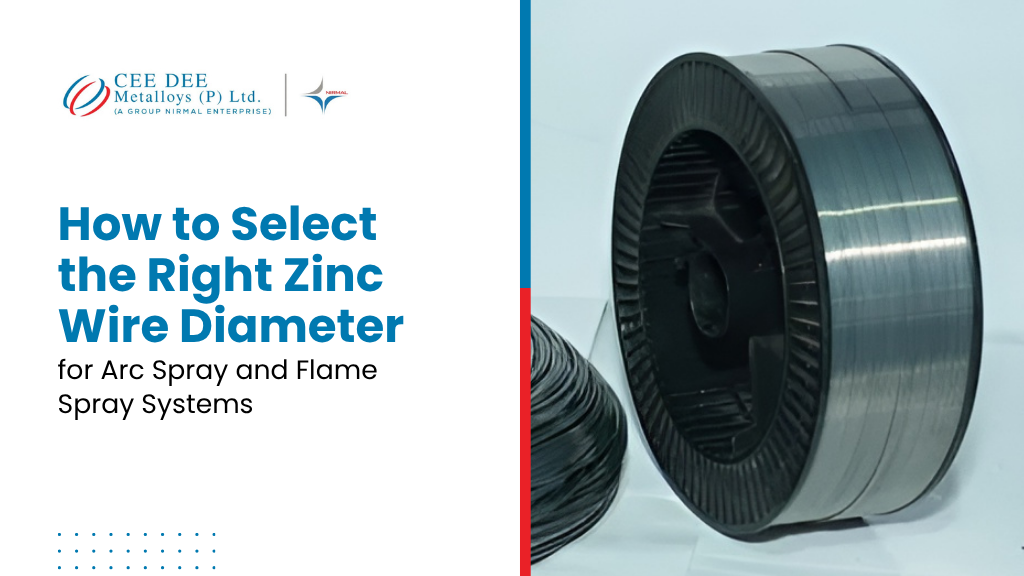
- Spool format is standard for thermal spray feedstock; spool dimensions must be confirmed against the wire feed unit specification.
- Why Wire Diameter Matters in Thermal Spray
- Standard Zinc Wire Diameters and Their Characteristics
- Diameter Selection for Arc Spray Systems
- Diameter Selection for Flame Spray Systems
- Deposition Rate, Productivity, and Economic Implications
- Impact of Wire Diameter on Coating Quality
- Wire Diameter for Zinc-Aluminium and Tin-Zinc Alloy Wires
- Wire Diameter Selection: A Practical Decision Guide
- Wire Storage, Handling, and Quality Verification
- CeeDee Metalloys: Zinc Wire Supply Across India
- Related Reading
- Frequently Asked Questions
Selecting the correct zinc wire diameter is a fundamental but sometimes overlooked aspect of thermal spray coating system design. While much attention is paid to feedstock alloy purity and spray process parameters, wire diameter has a direct and quantifiable effect on deposition rate, coating surface roughness, droplet size distribution, and ultimately the corrosion resistance of the applied coating. Getting this specification wrong means either underperforming equipment or a coating that fails to meet the project quality standard.
This technical guide from CeeDee Metalloys provides a comprehensive reference for engineers, procurement managers, and coating contractors selecting zinc wire and zinc-aluminium wire diameters for arc spray and flame spray systems used in industrial corrosion protection applications. We cover the standard sizes available, their technical characteristics, equipment compatibility constraints, and the practical selection criteria that govern the optimal choice for each application type.
1. Why Wire Diameter Matters in Thermal Spray
In both arc spray and flame spray processes, the metal wire feedstock is the source of all deposited material. The wire diameter determines the cross-sectional area of metal available for melting per unit length of wire, directly setting an upper limit on the deposition rate for any given wire feed speed. Beyond deposition rate, wire diameter influences the droplet size distribution of the sprayed particles: larger wires melt to produce larger average droplet sizes, while smaller wires produce finer droplets. Droplet size in turn affects coating surface roughness, porosity, and the degree of spreading and deformation on impact with the substrate.
Wire diameter must also be matched to the gun’s wire feed mechanism. Arc spray and flame spray guns are designed around a specific range of wire diameters that their drive rollers, contact tips, and nozzle geometries can accommodate. Operating outside this range causes wire feed inconsistency, arc instability (in arc spray), or uneven melting (in flame spray), all of which translate directly into coating quality defects. Consult the quality assurance documentation for your specific gun model before specifying feedstock wire diameter.
A dimensional tolerance of plus or minus 0.05mm for 3.17mm zinc wire is the industry standard requirement. Wire that deviates beyond this tolerance causes erratic feed, arc instability in arc spray systems, and variable deposition rates that make it impossible to maintain consistent coating thickness. Always request dimensional certification with feedstock orders.
2. Standard Zinc Wire Diameters and Their Characteristics
Zinc wire for thermal spray is manufactured in a range of diameters, with the market heavily concentrated around a small number of standard sizes that correspond to the design specifications of commercial spray gun equipment.
2.34mm Wire
2.34mm (approximately 3/32 inch or 0.092 inch) zinc wire is a smaller diameter option used in arc spray and flame spray applications requiring finer coating control, lower deposition rates, or when working with gun models specifically designed for this size. The finer wire produces smaller average droplets and a slightly smoother coating surface, which can be advantageous in applications where surface finish quality is important. Deposition rate is lower than 3.17mm wire at equivalent feed speed and current settings.
3.17mm Wire
3.17mm (1/8 inch or 0.125 inch) is by far the most widely used diameter for zinc wire in global thermal spray markets. It represents the default specification for the majority of commercial arc spray and flame spray gun models, including most systems used in the Indian industrial coating sector. The large installed base of equipment designed for this diameter makes 3.17mm zinc wire the most accessible and economical choice for most projects. CeeDee Metalloys zinc wire is available in 3.17mm as the primary commercial offering.
4.76mm Wire
4.76mm (3/16 inch) zinc wire is used in high-volume production arc spray systems where maximum deposition rate is the primary objective. The larger cross-section delivers approximately 2.25x the material volume per unit length compared with 3.17mm wire. This size requires arc spray guns specifically designed for larger wire and is not compatible with standard flame spray guns. It is most commonly encountered in automated or robotic arc spray installations for large-scale fabrication shop metallizing.
3. Diameter Selection for Arc Spray Systems
In arc spray, the wire diameter interacts with arc voltage and current to determine the rate of wire melting, the temperature and energy of the molten droplets, and the characteristics of the spray plume. The arc is struck between the tips of two wires fed from separate spools, so both wires must be of identical diameter and specification.
Standard Arc Spray Wire Diameters
The vast majority of commercial arc spray gun models, including the systems available through CeeDee Metalloys metallizing spray machines, are designed for 3.17mm wire as the primary feedstock diameter. Some models also accept 2.34mm wire at reduced output settings. High-volume production guns specifically designed for 4.76mm wire exist but represent a small fraction of the installed base. Always confirm the wire diameter range specified in the gun operating manual before ordering feedstock.
Current and Voltage Settings for Different Diameters
Larger diameter wire requires proportionally higher current to maintain the same wire melt rate. For 3.17mm zinc wire, a typical arc spray operating range is 150-250A at 18-24V. For 4.76mm wire, 250-400A is required to achieve comparable melt-through. The wire feed speed (in metres per minute) must be balanced with current setting to maintain a stable arc: too fast causes arc extinction, too slow causes arc wander and inconsistent droplet formation.
Need Zinc Wire in the Right Diameter for Your Equipment?
CeeDee Metalloys manufactures zinc wire and zinc-aluminium wire in standard diameters with certified dimensional tolerances. Contact us with your gun model and we will confirm the correct specification.
Request Wire Specifications4. Diameter Selection for Flame Spray Systems
Flame spray guns are designed around a fixed wire diameter that matches the inner bore of the wire guide, the drive roller groove geometry, and the nozzle aperture. Unlike arc spray, where some gun models accept a range of wire diameters through adjustable contact tips, most flame spray guns are optimised for a single wire diameter and cannot reliably process wire outside this specification.
Dominant Flame Spray Wire Diameter
3.17mm is the dominant wire diameter for flame spray zinc coating, matching the design specification of the most widely used commercial flame spray gun models globally and in India. 2.34mm wire is used in some specialised flame spray applications and with specific gun models designed for finer work. The 4.76mm diameter is not used in flame spray because the oxy-fuel flame does not generate sufficient heat flux to reliably melt larger wire cross-sections at practical feed rates.
Fuel Gas and Wire Diameter Interaction
The combustion temperature of the oxy-fuel flame must be sufficient to melt the wire at the feed rate required to maintain the target deposition rate. For zinc wire (melting point 419 degrees C), both oxy-acetylene and oxy-propane flames provide more than adequate energy for 3.17mm wire. For zinc-aluminium alloy wire (requiring higher temperature to melt the aluminium phase), oxy-acetylene is preferred over oxy-propane for reliable full melting across the wire cross-section.
5. Deposition Rate, Productivity, and Economic Implications
Wire diameter is the primary lever for adjusting the mass deposition rate of a thermal spray system when other parameters (feed speed, current/voltage or flame settings) are held constant. Understanding the quantitative relationship between wire diameter, feed speed, and deposition rate allows engineers to size feedstock requirements and project timelines accurately.
Calculating Deposition Rate
The theoretical deposition rate (in kg/hr) of a thermal spray system is proportional to the wire cross-sectional area multiplied by the linear wire feed speed and the wire density. For zinc (density 7.13 g/cm3), a 3.17mm wire fed at 6 m/min delivers approximately 6.4 kg/hr of zinc to the arc. With a typical deposition efficiency of 75%, approximately 4.8 kg/hr is incorporated into the coating, with the remainder lost as overspray and fume.
Economic Implications of Wire Diameter Selection
On a project requiring 1,000 m2 of zinc coating at 200 micrometres DFT (approximately 1.5 kg/m2 accounting for deposition efficiency), the total zinc wire consumption is approximately 1,500 kg. With 3.17mm arc spray wire at 8 kg/hr effective deposition rate, this coating requires approximately 187 hours of spray time. Upgrading to 4.76mm wire at 15 kg/hr reduces spray time to approximately 100 hours, a saving of 87 hours of gun operation. On large infrastructure projects, this productivity difference is commercially significant. The zinc wire cost per kilogram is the same regardless of diameter, so the economic benefit comes entirely from labour and equipment cost reduction.
6. Impact of Wire Diameter on Coating Quality
The influence of wire diameter on coating quality is secondary to process parameter control and surface preparation, but it is nonetheless measurable and relevant for applications with demanding coating quality specifications.
Surface Roughness
Smaller diameter wire melts into finer droplets that produce a smoother coating surface. For applications where a smooth surface is required to facilitate sealant penetration or topcoat adhesion, 2.34mm wire may provide a marginal advantage over 3.17mm wire. However, the difference is small relative to the effect of stand-off distance and air atomisation pressure, which are far more influential on coating surface roughness.
Coating Density
Finer droplets from smaller diameter wire tend to produce slightly higher coating density and lower porosity due to better inter-splat packing. However, this effect is more pronounced in high-velocity processes (HVOF, cold spray) than in arc spray or flame spray, where the dominant porosity driver is particle velocity rather than droplet size. For standard arc spray and flame spray zinc coatings, wire diameter has a secondary effect on porosity compared with air atomisation pressure and spray parameters.
7. Wire Diameter for Zinc-Aluminium and Tin-Zinc Alloy Wires
The same diameter standard applies to alloy zinc wires as to pure zinc wire. Zinc-aluminium wire (ZnAl4 and ZnAl15) is commercially available in 3.17mm diameter as the primary specification, matching the dominant equipment standard. Tin-zinc wire is also supplied in 3.17mm diameter for most commercial applications.
Dimensional Tolerance for Alloy Wires
Alloy zinc wires, particularly zinc-aluminium, are more demanding to draw to tight dimensional tolerances than pure zinc wire because the two-phase alloy microstructure creates different drawing characteristics. Reputable suppliers including CeeDee Metalloys maintain equivalent dimensional tolerances for alloy and pure zinc wires. Low-quality alloy wire with loose dimensional tolerances causes feeding problems that are particularly troublesome in arc spray systems with close contact tip clearances.
8. Wire Diameter Selection: A Practical Decision Guide
| Wire Diameter | Process Compatibility | Deposition Rate | Surface Finish | Best Application |
|---|---|---|---|---|
| 2.34mm | Arc spray, Flame spray (specific guns) | Low | Fine | Precision coating, fine detail work |
| 3.17mm | Arc spray, Flame spray (universal) | Medium | Standard | General industrial and structural coating |
| 4.76mm | Arc spray only (high-volume guns) | High | Coarser | Large-area production arc spray |
Decision Logic Summary
For most standard industrial and structural corrosion protection projects using commercial arc spray or flame spray equipment, 3.17mm zinc wire is the correct and optimal choice. It is compatible with essentially all commercial gun models, provides the best availability and competitive pricing, and delivers deposition rates and coating quality suitable for the full range of ISO 2063 coating thickness specifications. Specify 2.34mm wire only if your gun model requires it or if a very fine coating surface is a specific project requirement. Specify 4.76mm wire only if you are operating a high-volume production arc spray system specifically designed for this wire size. Contact the CeeDee Metalloys technical team with your gun model details for a confirmed diameter recommendation.
9. Wire Storage, Handling, and Quality Verification
The dimensional integrity and surface cleanliness of zinc wire have a direct bearing on spray performance and coating quality. Correct storage and handling practices preserve wire quality from delivery to final use.
Storage Conditions
Zinc wire should be stored in dry, covered conditions, away from moisture and corrosive environments. Prolonged exposure to moisture causes surface oxidation (zinc oxide formation) on the wire surface that can affect arc initiation in arc spray and melt consistency in flame spray. Spools should be stored off the floor on rack systems and rotated on a first-in, first-out basis to prevent extended storage times. Maximum recommended storage time before use is 12-18 months for zinc wire stored in appropriate conditions.
Quality Verification
Incoming zinc wire quality should be verified against the material test report supplied by the manufacturer. Key parameters to check are wire diameter (at minimum 3 measurement points per spool), purity (minimum 99.995% Zn for SHG grade), surface condition (free from oil, oxidation, and mechanical damage), and spool dimensions (confirm compatibility with wire feed unit). The quality assurance programme at CeeDee Metalloys provides full traceability documentation with every batch of zinc wire supplied.
External Reference Standards
Wire quality specifications are governed by ISO 752 (Zinc Alloys) for purity and ASTM B833 (Standard Specification for Zinc and Zinc-Alloy Wire for Thermal Spray) for dimensional and mechanical requirements. ASTM International publishes comprehensive wire testing protocols. The International Zinc Association maintains guidance on zinc feedstock quality for thermal spray applications. NACE International SP0215 provides recommendations for thermal spray coating application practices. The American Welding Society AWS C2.18 standard covers feedstock wire specifications for metallic thermal spray coatings.
Key Takeaways
- 3.17mm is the universal standard diameter for zinc wire used in both arc spray and flame spray, compatible with most commercial gun models.
- Wire diameter directly affects deposition rate: 4.76mm delivers 2.25x the material per unit length of 3.17mm wire, significantly increasing production output.
- Smaller diameters (2.34mm) produce finer droplets and marginally smoother coating surfaces but at lower deposition rates and with limited equipment compatibility.
- Equipment compatibility is the binding constraint: always confirm wire diameter with the gun manufacturer’s specification before ordering feedstock.
- Dimensional tolerance of plus or minus 0.05mm is mandatory for reliable wire feed in both arc spray and flame spray systems.
- Zinc-aluminium and tin-zinc alloy wires follow the same diameter standards as pure zinc wire and should be procured to equivalent dimensional tolerances.
- Correct storage in dry, covered conditions and first-in, first-out rotation preserves wire quality from delivery to application.
10. CeeDee Metalloys: Zinc Wire Supply Across India
- Zinc Wire Manufacturers in Delhi
- Zinc Wire Manufacturers in Uttar Pradesh
- Zinc Wire Manufacturers in Gujarat
- Zinc Wire Manufacturers in Haryana
- Zinc Wire Manufacturers in Rajasthan
- Zinc Wire Manufacturers in Kolkata
- Zinc Wire Manufacturers in Raipur
- Zinc Wire Manufacturers in Odisha
- Zinc Wire Manufacturers in Gurgaon
11. Related Reading
Frequently Asked Questions
What is the most common zinc wire diameter used for arc spray?
The most widely used diameter for arc spray zinc wire is 3.17mm (1/8 inch or approximately 3.2mm). This size offers the best combination of deposition rate, spooling characteristics, and compatibility with the majority of commercial arc spray gun models. Some high-volume production arc spray systems use 4.76mm wire for maximum deposition rate.
What zinc wire diameter is used for flame spray?
Flame spray guns are most commonly designed for 3.17mm (1/8 inch) zinc wire, which is the dominant diameter in the global market. Some flame spray systems designed for finer coating control use 2.34mm wire. The gun manufacturer’s specification should always be consulted to confirm the compatible wire diameter range before purchasing feedstock.
Does wire diameter affect coating quality?
Yes. Smaller diameter wire produces finer droplets on melting, which results in a slightly denser coating with lower surface roughness. Larger diameter wire produces coarser droplets, a slightly rougher coating surface, and higher deposition rates. For applications requiring a fine surface finish or very precise coating thickness control, smaller wire diameters are preferred. For maximum production output on large area coatings, larger diameters are chosen.
Can I use the same wire diameter for both zinc wire and zinc-aluminium wire?
In most cases, yes. If your equipment is designed for 3.17mm zinc wire, it will typically also handle 3.17mm zinc-aluminium wire of the same outer diameter. Always confirm with the wire manufacturer that the zinc-aluminium wire has the same dimensional tolerances as the zinc wire your equipment is calibrated for, as tight dimensional tolerances are essential for consistent wire feed.
What happens if I use a wire diameter outside the equipment specification?
Using a wire diameter that is too large for the gun will cause wire feed jamming, inconsistent arc stability in arc spray, and uneven melting in flame spray. A wire that is too small will lead to erratic feeding, arc wandering in arc spray, and reduced deposition rates. Either scenario produces an inconsistent coating that will not meet quality standards. Always match the wire diameter to the gun manufacturer’s specification.
How does wire diameter affect the amount of zinc deposited per hour?
Deposition rate scales approximately with the cross-sectional area of the wire, meaning that doubling the wire diameter approximately quadruples the mass of material available per unit length of wire fed. In practice, arc spray with 3.17mm zinc wire at 200A deposits approximately 8-10 kg/hr, while 4.76mm wire at the same settings deposits 15-20 kg/hr. Flame spray rates scale similarly but at lower absolute values due to lower deposition efficiency.
Is zinc wire supplied on spools or in straight lengths?
Zinc wire for thermal spray is almost exclusively supplied on spools for arc spray and flame spray applications, as continuous wire feed is essential for both processes. Common spool weights are 5kg, 10kg, and 25kg. CeeDee Metalloys supplies zinc wire on customised spool sizes to match customer equipment and project requirements, with spool dimensions specified to fit the wire feed systems on common gun models.
Does wire diameter affect the dimensional tolerance requirements?
Yes. Tighter diameter tolerances are required for smaller wire sizes because the percentage deviation for a given absolute dimensional error is larger for small wires. For 3.17mm zinc wire, the standard tolerance is typically plus or minus 0.05mm. Wire outside this tolerance causes inconsistent feed rates and variable arc or flame characteristics. CeeDee Metalloys manufactures zinc wire to tight dimensional tolerances with full material test report documentation for every batch.