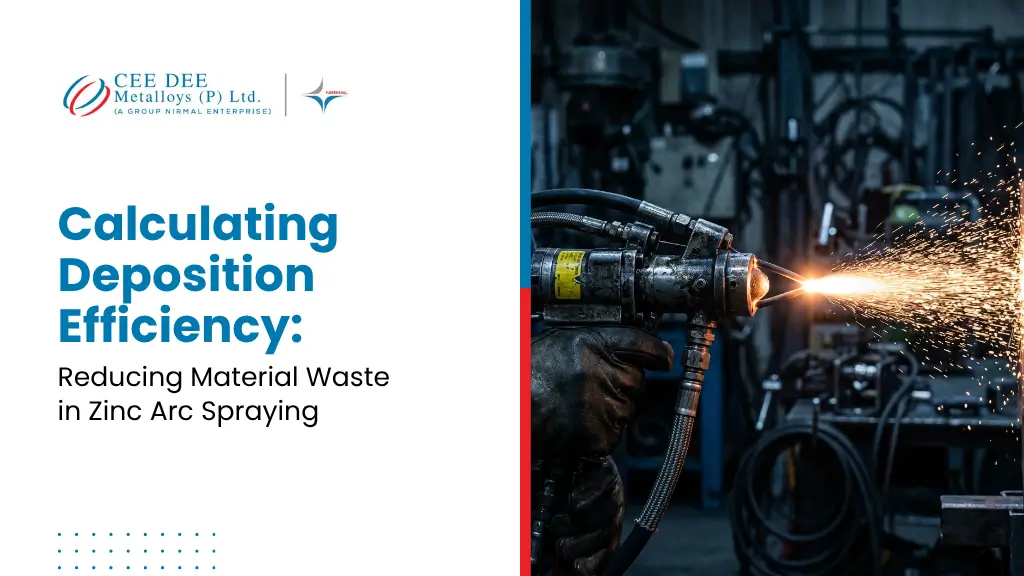
For any fabricator, EPC contractor, or galvanizing alternative shop running twin wire arc spray equipment, zinc wire is one of the largest recurring line items on a project budget. Yet a surprising number of metallizing operations never measure how much of that wire actually ends up as usable coating versus how much is lost as overspray, rebound, and oxidation fines. This article walks through exactly how to calculate deposition efficiency in zinc arc spraying, what drives material loss, and the practical adjustments that reduce zinc wire waste on the shop floor. CeeDee Metalloys supplies zinc wire and zinc aluminium wire to metallizing shops across India, and this guide reflects the same process variables our quality assurance team reviews with customers during technical support calls.
Key Highlights
- Deposition efficiency is the ratio of coating mass deposited to wire mass consumed, expressed as a percentage.
- Typical twin wire arc spray efficiency for zinc ranges from 45 percent to over 70 percent depending on parameters.
- Stand off distance, atomising air pressure, and spray angle are the three highest impact variables.
- Wire diameter consistency and surface finish materially affect droplet formation and rebound.
- A 20 point efficiency improvement can cut zinc wire consumption by close to a third on large projects.
- Overspray collection and substrate preparation both play a direct role in measured efficiency.
In This Article
- What Is Deposition Efficiency in Zinc Arc Spraying?
- How Deposition Efficiency Is Calculated
- Types of Material Loss in Arc Spray Metallizing
- Where Deposition Efficiency Matters Most
- Industry Applications of High Efficiency Zinc Arc Spraying
- Commercial and Project Level Benefits of Higher Efficiency
- Speciality and Niche Applications
- How to Choose Wire and Spray Parameters
- Performance, Maintenance and Best Practices
- Who Uses Deposition Efficiency Calculations?
- Related Reading
- Frequently Asked Questions
1. What Is Deposition Efficiency in Zinc Arc Spraying?
Deposition efficiency describes how much of the zinc wire fed into a twin wire arc spray gun actually ends up bonded to the substrate as usable coating, compared to the total wire mass consumed during the run. In the arc spray process, an electric arc melts the tips of two converging zinc wires, and compressed air atomises the molten zinc into a stream of fine droplets that are propelled toward the part. Not every droplet reaches the surface in a useful state. Some droplets cool and solidify in flight, some bounce off the substrate on impact, and some drift away as airborne overspray before they ever make contact.
Deposition efficiency is therefore not a measure of coating quality or adhesion strength in isolation, but a measure of process economy: how efficiently raw zinc wire is being converted into finished coating thickness on the part. A shop running at 70 percent efficiency uses roughly 30 percent less wire than a shop running at 49 percent efficiency to achieve the same coating build on the same surface area.
Deposition efficiency and coating quality are related but separate metrics. A process can have excellent bond strength and porosity figures while still wasting a large share of wire as overspray. Tracking efficiency alongside quality checks gives a complete picture of process health.
2. How Deposition Efficiency Is Calculated
The calculation itself is straightforward, but it depends on accurate mass measurements taken before and after a spray run. The standard formula used across thermal spray operations is:
Deposition Efficiency (%) = (Mass of Coating Deposited on Part / Mass of Wire Consumed) x 100
Mass of coating deposited is found by weighing the part before and after spraying. Mass of wire consumed is found by weighing the wire spool, or measuring wire feed length and converting to mass using the wire diameter and density, before and after the same run.
Worked Example
Consider a structural steel bracket weighing 12.400 kilograms before metallizing. After a single spray pass targeting 100 microns of zinc coating, the part weighs 12.487 kilograms, a coating gain of 87 grams. During that same pass, the wire feeder consumed 150 grams of zinc wire, measured by spool weight difference. Applying the formula gives a deposition efficiency of (87 / 150) x 100, which equals 58 percent. This means 42 percent of the wire fed into the gun during that pass did not end up as coating on the part.
Why Batch Measurement Beats Single Part Measurement
On a production run with many similar parts, it is more reliable to measure total wire consumption against total coating mass across a batch rather than a single part, since this averages out small weighing errors and edge effects on individual components. Many shops track this as a recurring KPI alongside the process parameters logged for each job, which also supports traceability during quality assurance audits.
3. Types of Material Loss in Arc Spray Metallizing
Understanding where the missing material goes is the first step toward recovering it. Material loss in zinc arc spraying generally falls into four categories.
Overspray
Overspray is molten or semi molten zinc that misses the target area entirely, typically because the spray pattern is wider than the part, the gun is angled incorrectly, or the operator is spraying past the edge of the component during pass transitions.
Rebound
Rebound occurs when droplets strike the substrate but bounce off rather than bonding, usually because the droplets have cooled too much in flight, the surface profile is too smooth, or the impact angle is too shallow.
Oxidation and Fume Loss
A portion of atomised zinc oxidises in flight and is carried away as fine particulate fume rather than landing as coating. This is more pronounced with excessive atomising air pressure or excessive stand off distance.
Wire Feed Inconsistency
Uneven wire feed speed, caused by feed roller wear, wire diameter variation, or contact tip wear, disrupts the stability of the arc and increases the proportion of large, poorly atomised droplets that are more likely to rebound or fall as spatter.
| Loss Type | Primary Cause | Typical Share of Total Loss |
|---|---|---|
| Overspray | Wide spray pattern, incorrect gun angle | 35 to 45 percent |
| Rebound | Excess stand off distance, poor surface profile | 25 to 35 percent |
| Oxidation and fume | High atomising air pressure | 15 to 25 percent |
| Wire feed inconsistency | Worn contact tips, feed roller slip | 5 to 15 percent |
4. Where Deposition Efficiency Matters Most
Deposition efficiency is not equally critical on every job. It becomes a significant cost factor on large surface area work where wire consumption scales directly with project size, such as bridge girders, storage tanks, wind turbine towers, and offshore structures. On these projects, even a modest efficiency improvement compounds across tonnes of zinc aluminium wire or pure zinc wire consumed over the contract duration.
It matters less, in relative terms, on small precision components where wire consumption per part is already low, though consistency still affects coating thickness control and rework rates on those parts.
📖 Also Read: Zinc Aluminium Wires: Metal Protection Benefits
5. Industry Applications of High Efficiency Zinc Arc Spraying
Industries that rely heavily on zinc arc spraying for corrosion protection have the most to gain from tight deposition efficiency control. Infrastructure projects involving bridges and structural steelwork, marine and offshore platforms, renewable energy structures such as wind towers, and railway infrastructure all consume large volumes of zinc wire as a galvanizing alternative, making material yield a direct line item in project margins. CeeDee Metalloys works with fabricators across these sectors, supplying wire alongside the zinc metallizing spray machines used to apply it. A full sector breakdown is available on our applications page.
Need Help Calculating Wire Requirements for Your Next Project?
Our technical team can help estimate zinc wire consumption based on your target coating thickness and expected deposition efficiency.
Talk to Our Team6. Commercial and Project Level Benefits of Higher Efficiency
Beyond raw material savings, improved deposition efficiency reduces several secondary costs that are often overlooked in project budgeting. Fewer spool changeovers mean less downtime per shift. Reduced overspray means less cleanup, less particulate to manage, and lower housekeeping overhead in the spray booth. Tighter, more consistent coating builds also reduce rework rates caused by under thickness areas that need a second pass. On contract metallizing work priced per square metre, these secondary savings can be as significant as the wire cost reduction itself.
7. Speciality and Niche Applications
Some applications call for tighter efficiency and purity control than general structural metallizing. Sacrificial anode and cathodic protection work, where coating uniformity directly affects service life predictions, benefits from consistent, well documented deposition efficiency records. Specialist products such as Bio-Zinc are formulated for applications where coating consistency and environmental considerations are equally important, while tin zinc wire is used in electronics and capacitor related coating work where deposition control affects functional performance rather than just corrosion resistance.
📖 Also Read: Use of Zinc in Electronics
8. How to Choose Wire and Spray Parameters
Selecting the right wire diameter, alloy, and spray parameters for a given job starts with the target coating thickness and the substrate geometry. Thicker, more consistent wire with tight diameter tolerance feeds more predictably through the gun, which directly improves arc stability.
Wire Selection
For general structural corrosion protection, pure zinc wire remains the standard choice. For projects requiring extended service life in marine or high corrosivity environments, zinc aluminium wire typically delivers better long term performance per micron of coating, which can offset a slightly different efficiency profile compared to pure zinc.
Parameter Selection
Stand off distance, atomising air pressure, voltage, and wire feed speed should be set according to the gun manufacturer’s recommended range for the wire diameter in use, then fine tuned on a test panel before production spraying begins. Spraying a calibration panel and weighing it before committing to a full production run is the single most effective way to confirm expected efficiency before wire is committed to a large job.
📖 Also Read: Zinc Rods: Uses in Industrial Coatings
9. Performance, Maintenance and Best Practices
Sustaining good deposition efficiency over time is as much about equipment maintenance as initial setup. Contact tips wear with use and should be replaced on a defined schedule rather than run to failure, since worn tips destabilise the arc gradually and efficiency drift can go unnoticed until a batch weighing check is performed. Feed rollers should be checked for wear and correct tension regularly, since slipping rollers cause inconsistent wire feed speed even when the feeder display shows a steady setpoint.
Operator Technique
Consistent gun travel speed, correct overlap between passes, and maintaining the recommended stand off distance throughout the pass, including around edges and corners, all contribute meaningfully to measured efficiency. Operator training and periodic technique audits are a low cost way to recover efficiency losses that have nothing to do with equipment condition.
Logging deposition efficiency by operator, not just by job, often reveals technique related variance that pure equipment maintenance records will not show.
📖 Also Read: 10 Lesser Known Industrial Applications of Zinc Rods
10. Who Uses Deposition Efficiency Calculations?
Deposition efficiency tracking is most actively used by metallizing contractors, structural steel fabricators, EPC contractors managing corrosion protection scope, and shipyards running large scale arc spray operations. CeeDee Metalloys supplies zinc wire to fabricators and contractors across India, including teams working on infrastructure and industrial projects in the regions below.
CeeDee Metalloys Zinc Wire Supply Regions
Beyond geography, our technical service support helps customers troubleshoot deposition efficiency issues directly, drawing on metallurgical data referenced in independent thermal spray literature such as the Thermal Spray Society guidelines and process notes published by TWI Global on arc spray parameter optimisation.
11. Related Reading
Articles
Key Takeaways
- Deposition efficiency equals coating mass deposited divided by wire mass consumed, expressed as a percentage.
- Typical zinc arc spray efficiency ranges from 45 to over 70 percent depending on setup and technique.
- Overspray and rebound together usually account for the majority of material loss.
- Stand off distance, atomising air pressure, and spray angle are the highest leverage adjustments.
- Wire quality and diameter consistency directly affect arc stability and droplet formation.
- Logging efficiency by job and by operator helps isolate equipment issues from technique issues.
- Even modest efficiency gains translate into measurable wire cost savings on large projects.
12. Frequently Asked Questions
What is a good deposition efficiency for zinc arc spraying?
Well tuned twin wire arc spray systems running zinc wire typically achieve deposition efficiency in the 55 to 70 percent range under workshop conditions, with optimised parameters and shrouded guns pushing past 70 percent. Anything below 45 percent usually signals a parameter, wire, or technique problem worth investigating.
How do you calculate deposition efficiency in thermal spraying?
Deposition efficiency is the ratio of the mass of coating actually deposited on the substrate to the total mass of wire consumed during spraying, expressed as a percentage. It is measured by weighing the part before and after spraying, then weighing the wire spool before and after the same run, and dividing the coating mass gained by the wire mass consumed.
What causes low deposition efficiency in arc spraying?
Low deposition efficiency is usually caused by excessive atomising air pressure, incorrect stand off distance, poor spray angle, worn contact tips, inconsistent wire feed speed, or spraying onto a substrate that has not been properly roughened. Each of these increases overspray and particle rebound.
Does zinc wire quality affect deposition efficiency?
Yes. Wire diameter tolerance, surface finish, and consistent metallurgical composition all influence how evenly the arc melts the wire tip. Inconsistent wire can cause irregular droplet formation, which increases overspray and lowers deposition efficiency even when machine settings are correct. See our quality assurance process for how this is controlled.
How much does improving deposition efficiency save on material cost?
Moving deposition efficiency from around 45 percent to 65 percent on a large structural steel project can reduce zinc wire consumption by close to a third for the same coating thickness, which directly lowers material spend, spool changeovers, and disposal volumes of overspray waste.
What is the difference between deposition efficiency and deposition rate?
Deposition efficiency measures how much of the sprayed material actually sticks to the part as a percentage of wire consumed. Deposition rate measures how quickly coating builds up, usually in kilograms per hour. A system can have a high deposition rate and still waste a large share of material if efficiency is poor.
Can deposition efficiency be improved without buying new equipment?
In most cases yes. Adjusting stand off distance, atomising air pressure, spray angle, and wire feed speed, combined with proper surface preparation and operator technique, recovers a meaningful share of efficiency on existing arc spray equipment before any capital investment is needed.
Is overspray from zinc arc spraying hazardous waste?
Zinc overspray and particulate fallout should be collected and managed according to local environmental regulations, since fine metal particulate can pose respiratory and housekeeping risks in the workshop even where it is not classified as hazardous waste.
Does stand off distance really make a measurable difference to efficiency?
Yes, stand off distance is one of the most sensitive variables in arc spraying. Spraying too far from the substrate lets particles cool and lose momentum before impact, increasing rebound, while spraying too close concentrates heat and can cause substrate distortion, both of which reduce effective deposition efficiency.