Every structural engineer, corrosion specialist, and fabricator making coating decisions for long life steel structures eventually confronts the same fundamental question: why does a zinc coating continue to protect steel long after it has been scratched, cut, or damaged, when an apparently intact paint or epoxy barrier fails from the inside out? The answer lies in the galvanic series, one of the most practically important concepts in materials science. CeeDee Metalloys manufactures and supplies zinc wire, zinc aluminium wire, and zinc metallizing spray machines for arc spray corrosion protection across India, and the electrochemistry of zinc sacrifice is central to everything we supply. This article explains how the galvanic series works, why zinc is uniquely positioned in it, and why that positioning makes zinc metallizing coatings fundamentally superior to barrier-only approaches for structural steel protection.
Key Highlights
- The galvanic series ranks metals by electrochemical potential, determining which corrodes when two metals meet in an electrolyte.
- Zinc is anodic relative to steel, meaning zinc corrodes preferentially and actively protects steel as a sacrificial anode.
- Barrier coatings rely on physical exclusion of moisture; any holiday, scratch, or cut edge triggers localised corrosion that undercuts the coating.
- Zinc coatings are self-healing at damaged areas because the electrochemical protection extends laterally beyond the coating edge.
- Zinc aluminium alloy wire combines sacrificial galvanic protection with an enhanced barrier effect for extended service life.
- Documented field studies show zinc metallized coatings maintaining structural steel integrity for over 40 years in atmospheric exposure.
In This Article
- What Is the Galvanic Series?
- The Electrochemical Mechanism of Sacrificial Protection
- Types of Corrosion Protection: Sacrificial vs Barrier
- Why Zinc Is the Ideal Sacrificial Metal for Steel
- Industry Applications of Zinc Galvanic Protection
- Commercial and Project Level Benefits
- Speciality Applications Where Zinc Outperforms All Alternatives
- How to Choose: Wire Grade and Coating System Selection
- Performance, Maintenance and Best Practices
- CeeDee Metalloys Serves Fabricators Across India
- Related Reading
- Frequently Asked Questions
1. What Is the Galvanic Series?
The galvanic series is a table that ranks metals and alloys according to their electrochemical potential measured in a standard electrolyte, most commonly aerated seawater at a specific temperature. At one end of the scale sit the most active or anodic metals, which release electrons readily and corrode most easily when connected to a more noble metal. At the other end sit the most noble or cathodic metals, such as platinum and gold, which are highly resistant to oxidation and receive electrons rather than donating them when paired with more active metals.
The positions in the galvanic series are not fixed in absolute terms, they shift somewhat with electrolyte composition, temperature, and whether the metal surface is in an active or passive state. What matters practically is the relative position of two metals that are in electrical contact through a conductive path and a shared electrolyte. The potential difference between them drives a current, and the more active metal becomes the anode in that electrochemical cell, corroding to supply the current while the more noble metal is cathodically protected.
Industry-standard references for the galvanic series are published by organisations including AMPP (formerly NACE International) and codified in material standards referenced by the ISO 9223 corrosivity classification framework. A detailed electrochemical explanation of galvanic coupling is also maintained in the Corrosionpedia galvanic series reference, which is widely used by engineers specifying corrosion protection systems.
2. The Electrochemical Mechanism of Sacrificial Protection
When zinc and steel are in electrical contact and exposed to a conductive electrolyte such as rainwater, seawater, or condensation containing dissolved salts, they form a galvanic couple. Zinc, sitting at approximately minus 1.1 volts versus the standard hydrogen electrode in seawater, is significantly more active than carbon steel at around minus 0.6 to minus 0.7 volts. This 0.4 to 0.5 volt potential difference is large enough to drive a meaningful protective current.
What Happens at the Zinc Anode
At the zinc surface, oxidation occurs. Zinc atoms lose electrons and go into solution as zinc ions: Zn becomes Zn2+ plus two electrons. These electrons flow through the metallic conductive path, which in a zinc metallized steel substrate is the steel itself, toward the steel surface. This means the steel surface is receiving electrons, which is exactly the cathodic protection condition required to suppress iron oxidation.
What Happens at the Steel Cathode
At the steel surface, the electrons arriving from the zinc support a reduction reaction, typically the reduction of dissolved oxygen in the electrolyte. Because the steel is now the cathode in the electrochemical cell, it cannot corrode: oxidation can only occur at the anode. The steel is protected as long as zinc is available to sustain the anodic reaction.
The key insight from the galvanic series is that zinc protection of steel is not passive or mechanical. It is an active, continuous electrochemical process. As long as any electrical continuity exists between the zinc and the steel, and as long as any zinc remains, the steel is protected even where it is exposed to the electrolyte.
The Self-Healing Zone
One of the most important practical consequences of this mechanism is that the cathodic protection current extends slightly beyond the physical edge of the zinc coating into bare exposed steel areas. Depending on the electrolyte conductivity and the coating thickness, this protective zone can extend two to four millimetres laterally from the coating boundary. This is the origin of the term sacrificial protection at cut edges that galvanizing and zinc metallizing both provide, and that no barrier coating can replicate.
3. Types of Corrosion Protection: Sacrificial vs Barrier
Corrosion protection strategies for steel fall into two fundamentally different categories, and understanding the distinction clarifies exactly why zinc behaves differently from paint, epoxy, or any other purely physical coating.
Barrier Protection
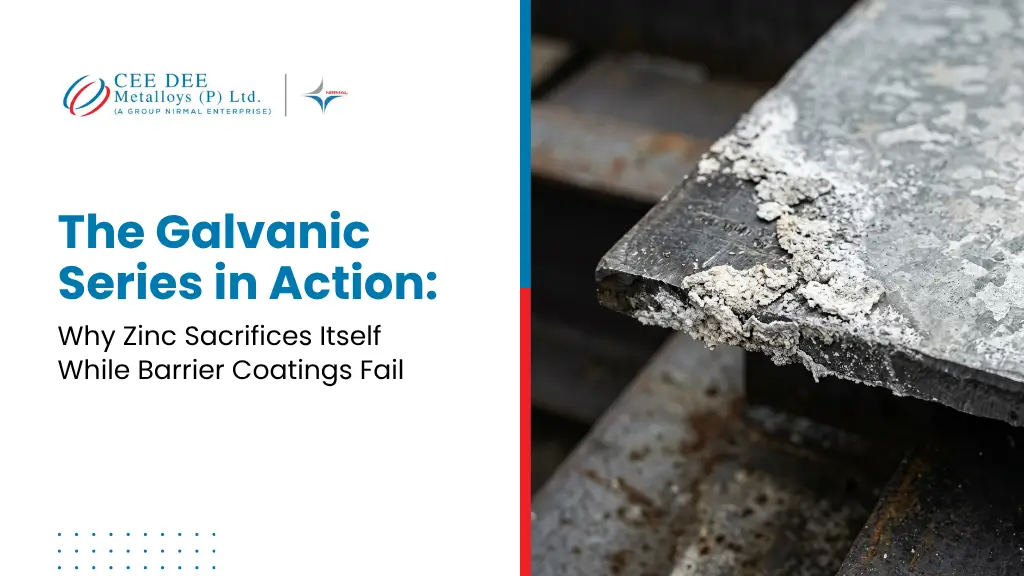
Barrier coatings work by physically separating the steel from the corrosive environment. Paint, epoxy, polyurethane, and coal tar coatings all function in this mode. When the barrier is perfect and intact, they work well. The critical weakness is that barrier coatings offer zero electrochemical protection. Any imperfection in the film, a scratch, a pinhole, a cut edge left uncoated, a disbonded area from impact, or a holiday missed during application, allows moisture and oxygen to reach the steel surface. Once contact is made, iron oxidation begins. As rust forms it occupies a greater volume than the original iron, which mechanically forces the coating away from the steel in a process called undercutting. The disbonded area grows invisibly under the coating, and the coating may appear intact over a large area that is already severely corroded underneath.
Sacrificial Protection
Sacrificial protection relies on electrochemistry rather than physical exclusion. The zinc coating on steel does not need to be a perfect seal. Because zinc is anodic relative to steel throughout the galvanic series, any path exists through which current can flow between zinc, steel, and electrolyte will result in zinc corroding preferentially and steel being protected. Damage to the coating does not trigger accelerated corrosion of the steel; it exposes more zinc to be sacrificed while the exposed steel remains protected.
| Property | Barrier Coating (Paint / Epoxy) | Zinc Sacrificial Coating (Arc Spray) |
|---|---|---|
| Protection mechanism | Physical exclusion of moisture and oxygen | Electrochemical sacrificial anode action |
| Behaviour at holidays and scratches | Localised corrosion begins immediately | Zinc sacrifices; steel remains protected |
| Behaviour at cut edges | Edge rust and underfilm spread | Cathodic protection extends 2 to 4 mm laterally |
| Self-healing capability | None | Yes, through galvanic current supply |
| Failure mode | Film disbonding, undercutting, blistering | Gradual consumption of zinc; predictable by thickness |
| Service life prediction | Difficult; depends on film integrity | Quantifiable based on zinc layer thickness and corrosivity category |
| Maintenance trigger | Film failure, often sudden and widespread | Gradual; recoating when zinc thickness depletes below threshold |
4. Why Zinc Is the Ideal Sacrificial Metal for Steel
The galvanic series contains many metals more active than zinc, including magnesium and lithium, so why is zinc the globally preferred sacrificial material for steel protection rather than these alternatives?
Corrosion Rate Is Controllable
Zinc corrodes at a rate that is slow enough to provide long service life from practical coating thicknesses, yet fast enough to provide meaningful electrochemical protection current. Magnesium, while more active, corrodes so rapidly in many electrolytes that it would be consumed within months at coating thicknesses achievable by arc spray. Zinc’s corrosion rate in typical atmospheric exposure is measured in microns per year, translating to decades of protection from a 100 to 200 micron coating.
Corrosion Products Are Protective
As zinc corrodes, it forms a complex of zinc oxide, zinc hydroxide, and zinc carbonate compounds collectively referred to as zinc patina. This patina is relatively insoluble and adheres to the coating surface, progressively slowing the zinc corrosion rate over time. The initial corrosion rate of a fresh zinc coating is higher than its long term rate, as the patina gradually passivates the surface. This behaviour is unique to zinc among commonly available structural coating materials and is a major reason why zinc coatings last far longer in real service than their initial measured corrosion rate would predict.
Abundance and Cost Efficiency
Zinc is abundant enough to be commercially viable as a coating material at industrial scale. It can be drawn into the zinc wire or cast into the zinc rods used in arc spray and rod spray metallizing processes, and it can be alloyed with aluminium to produce zinc aluminium wire that combines the sacrificial properties of zinc with enhanced barrier characteristics. Full background on the properties of zinc aluminium alloy coatings is covered in our article on zinc aluminium wires and metal protection benefits.
5. Industry Applications of Zinc Galvanic Protection
The galvanic protection principle underpinning zinc metallizing makes it relevant across every sector where steel is exposed to a corrosive environment for a service life that makes repeated maintenance painting uneconomical. The applications served by CeeDee Metalloys span bridges, marine structures, oil and gas facilities, wind turbines, railway infrastructure, and storage tanks, all sectors where the long term predictability of zinc’s sacrificial mechanism is a decisive advantage over barrier coatings.
Structural Steel and Infrastructure
Bridges, flyovers, and large structural steel frames represent the core market for zinc arc spray metallizing as a galvanizing alternative. These structures are expected to deliver service lives of 50 to 100 years with minimal recoating, a standard that barrier coatings alone cannot reliably meet without major maintenance cycles. Zinc metallizing from arc spray machines applied to properly prepared steel provides corrosion protection that is both electrochemically active and physically bonded through mechanical keying to the blast-cleaned surface.
Marine and Offshore
In the marine splash zone and in tidal zones, the combination of constant electrolyte availability and high chloride concentration creates the most demanding corrosion conditions that structural steel encounters in practice. Pure zinc wire arc spray and zinc aluminium wire metallizing both perform far beyond the capability of barrier coatings in these environments, because the electrochemical protection mechanism does not degrade in the presence of the high-conductivity seawater electrolyte. Research published by TWI Global on thermal spray coating performance in marine environments confirms service lives exceeding 30 years without maintenance recoating on zinc metallized offshore structures.
Find the Right Zinc Wire for Your Corrosion Protection Project
CeeDee Metalloys stocks pure zinc wire, zinc aluminium wire, and tin zinc wire in a range of diameters for arc spray and metallizing applications across India.
Get a Quote Today6. Commercial and Project Level Benefits of Zinc Galvanic Protection
The electrochemical advantage of zinc over barrier coatings translates directly into project economics. The primary driver is maintenance cost over the structure’s life, not initial application cost. A zinc metallized coating applied once at construction and verified by thickness measurement will typically outlast three or four cycles of barrier coating maintenance painting on the same structure, each of which requires blast cleaning back to near white metal before recoating.
The ability to quantify remaining zinc service life by measuring coating thickness makes asset management straightforward. When zinc thickness depletes to a pre-defined minimum, the decision to recoat is based on objective measurement rather than visual judgement of paint condition, which is inherently subjective and often delayed until corrosion is already active. The quality assurance framework CeeDee Metalloys applies to its wire products supports this measurement based approach with consistent wire composition and diameter tolerances.
📖 Also Read: Zinc Rods: Uses in Industrial Coatings
7. Speciality Applications Where Zinc Outperforms All Alternatives
Beyond mainstream structural corrosion protection, there are specific application classes where zinc’s galvanic series position gives it advantages that no other affordable material can replicate.
Sacrificial Anodes for Buried Pipelines and Tanks
Buried steel pipelines and underground storage tanks are subject to soil corrosion that is electrochemical in nature and nearly impossible to inspect visually. Zinc rods used as sacrificial anodes in cathodic protection systems exploit the same galvanic series principle as arc spray metallizing, but in a discrete attached form rather than as a continuous coating. The zinc rod corrodes preferentially, supplying protection current through the soil electrolyte to the buried steel structure.
Electronics Shielding and Functional Coatings
In electronics, zinc-based coatings are used for electromagnetic shielding and as functional layers where the metallic conductivity and controlled galvanic properties of zinc contribute to component performance. Tin zinc wire is used in arc spray applications where the combined properties of tin and zinc are needed, including capacitor metallization and electronic component coating. The galvanic relationship between tin and zinc is itself exploited in some formulations to manage corrosion behaviour of the coating system. More detail is available in our post on the use of zinc in electronics.
Bio-Zinc for Sensitive Environmental Contexts
In applications near freshwater systems, agriculture, or where controlled zinc release is important, Bio-Zinc products formulated for reduced environmental impact leverage the same sacrificial properties as standard zinc while meeting stricter leachate and environmental discharge requirements. The galvanic protection mechanism remains identical; the difference lies in how the zinc corrosion products are managed.
📖 Also Read: 10 Lesser Known Industrial Applications of Zinc Rods
8. How to Choose: Wire Grade and Coating System Selection
Selecting between pure zinc wire and zinc aluminium wire is the first practical decision that follows from understanding the galvanic series. Both provide sacrificial protection for steel, but their performance profiles differ in ways that matter for specific service environments.
Pure Zinc Wire
Pure zinc wire, typically 99.99 percent purity for arc spray, provides the maximum electrochemical driving potential for sacrificial protection. It is the most active zinc product in the galvanic series position sense, and therefore provides the strongest cathodic protection current per unit area. It is the standard choice for mild to moderate atmospheric exposure, for underground cathodic protection, and for applications where pure zinc is required by specification.
Zinc Aluminium Wire
Zinc aluminium wire in the 85/15 zinc aluminium composition provides a coating that combines zinc’s galvanic activity with aluminium’s barrier contribution. The aluminium component encourages the formation of a denser, more adherent corrosion product layer on the coating surface, and the alloy as a whole tends to corrode at a slower rate than pure zinc in equivalent atmospheric conditions. For marine and high-corrosivity environments where service life extension per unit of coating thickness is the priority, zinc aluminium alloy is typically the preferred choice. Our article on zinc aluminium wires and metal protection benefits covers alloy performance data in detail.
Coating Thickness and Sealer Selection
Once wire grade is selected, coating thickness is specified according to the corrosivity category of the intended service environment, referencing standards such as ISO 2063 for thermal sprayed zinc coatings. Sealing the freshly applied zinc arc spray coating with a low viscosity sealer penetrates the natural porosity of the coating and significantly extends service life by restricting electrolyte ingress into the coating structure itself, as distinct from the steel-coating interface. This is covered in detail in the service and application guidance provided by CeeDee Metalloys.
📖 Also Read: Tin Zinc Wires for Industrial Coatings
9. Performance, Maintenance and Best Practices
Understanding the galvanic series helps set realistic expectations for zinc coating behaviour in service, which in turn informs the most effective maintenance strategy.
Monitoring Zinc Coating Condition
The most reliable indicator of remaining service life for a zinc metallized coating is residual coating thickness measured with a calibrated electromagnetic thickness gauge. Unlike paint, which can appear intact while corrosion spreads underneath, a zinc coating in service provides reliable thickness readings that directly translate into remaining electrochemical protection capacity. Periodic thickness checks on representative locations across the structure provide the data needed to schedule recoating before protection drops below the minimum threshold.
Surface Preparation Before Metallizing
The bond strength and electrochemical continuity of a zinc arc spray coating depend heavily on the quality of surface preparation. Blast cleaning to Sa 2.5 or Sa 3 to ISO 8501-1, with a surface profile in the range of 50 to 100 microns, creates the mechanical interlock required for good coating adhesion. A zinc coating applied to an inadequately prepared surface may spall, disrupting the galvanic couple with the steel and reducing effective protection regardless of nominal coating thickness. Guidance on preparation and application is provided through CeeDee Metalloys service and technical support.
The TWI Global Knowledge Summary on thermal spray coatings for corrosion protection notes that surface preparation accounts for more variation in thermal spray coating performance than any other single process variable. Zinc arc spray applied to an incorrectly prepared substrate does not fully realise the galvanic protection its thickness would theoretically provide.
Field Repair of Damaged Zinc Coatings
Where zinc coatings are mechanically damaged during fabrication, transport, or erection, field repair using portable arc spray equipment restores both the barrier and the galvanic protection. Cold galvanizing compounds based on zinc-rich paint can be used for small repairs where arc spray access is impractical, but the zinc particle loading in such compounds produces a lower quality galvanic couple than thermally sprayed metallic zinc, making them suitable only for temporary or minor repairs. The ASM Thermal Spray Society publishes repair specification guidance covering these scenarios.
📖 Also Read: Tin Zinc Wires for Industrial Coatings
10. CeeDee Metalloys Serves Fabricators Across India
CeeDee Metalloys supplies zinc wire, zinc aluminium wire, and complete metallizing solutions to corrosion protection contractors, structural steel fabricators, and EPC project teams operating across Indian industrial and infrastructure markets. Our wire products are manufactured to support the full galvanic protection chain from electrochemical design to final coating thickness verification. Explore our supply reach across key fabrication and manufacturing regions below.
Zinc Aluminium Wire Supply Regions
Key Takeaways
- The galvanic series ranks zinc as anodic relative to steel, making zinc a natural sacrificial protector in any electrolyte that connects the two metals.
- Sacrificial protection is active and self-healing at damaged areas; barrier protection collapses at any coating defect.
- Zinc corrosion products form a protective patina that slows zinc consumption over time, extending service life beyond initial rate predictions.
- Zinc aluminium wire coatings combine sacrificial galvanic action with improved barrier characteristics for longer service life per micron.
- Coating thickness measurement provides a direct, quantifiable assessment of remaining service life for zinc arc spray coatings.
- Surface preparation quality is the single largest variable affecting whether the zinc-steel galvanic couple functions as designed.
- Zinc metallizing is accepted under ISO 2063 as a structural steel corrosion protection method with documented service lives exceeding 40 years.
11. Related Reading
Articles
12. Frequently Asked Questions
What is the galvanic series and why does it matter for corrosion protection?
The galvanic series is a ranking of metals and alloys from most active (anodic) to most noble (cathodic) based on their electrochemical potential in a given electrolyte, usually seawater or a similar conductive medium. When two dissimilar metals are in electrical contact in the presence of an electrolyte, the more active metal corrodes preferentially and protects the more noble one. Zinc sits well above steel in the active direction, which is why it sacrifices itself to protect iron and steel substrates.
Why do barrier coatings fail while zinc coatings continue to protect?
Barrier coatings fail because any break, holiday, scratch, or cut edge in the coating exposes bare steel directly to the environment. Once moisture penetrates, rusting begins and often spreads laterally under the coating through undercutting. Zinc coatings do not rely on being a complete physical seal. Even where the zinc is scratched or damaged, the electrochemical potential difference between zinc and steel means zinc continues to act as a sacrificial anode and protects the exposed steel electrochemically.
How far does zinc sacrificial protection extend across bare steel?
In the arc spray zinc metallizing context, zinc sacrificial protection typically provides active cathodic protection to exposed steel over a lateral distance of around two to four millimetres from the coating edge, depending on the electrolyte conductivity and coating thickness. This is why cut edges on zinc metallized structural steel do not rust back rapidly the way painted cut edges do.
Is zinc aluminium wire more effective than pure zinc wire for sacrificial protection?
Zinc aluminium alloy coatings, typically in the 85 percent zinc and 15 percent aluminium composition, combine zinc’s sacrificial electrochemical activity with aluminium’s barrier properties and aluminium’s ability to form dense, self-sealing corrosion products. The result is a coating that lasts longer per micron of thickness than pure zinc in many atmospheric and marine environments. Our zinc aluminium wire page provides full specification data.
What is the difference between galvanic protection and cathodic protection?
Galvanic protection refers specifically to the electrochemical protection of one metal by a more active sacrificial metal when the two are in direct electrical contact, driven by the potential difference in the galvanic series. Cathodic protection is the broader term for any method that makes the target metal the cathode in an electrochemical cell, achievable galvanically using sacrificial anodes or using an impressed current from an external power supply.
Can zinc metallizing replace hot dip galvanizing for structural steel?
Zinc arc spray metallizing is widely accepted as a galvanizing alternative for structural steel, particularly for large or complex structures that cannot be immersion dipped, for field repairs, and for situations requiring on-site coating application. ISO 2063 governs zinc thermal spray coatings for steel protection in a way directly comparable to galvanizing standards, and zinc metallized coatings have demonstrated service lives exceeding 40 years in documented field exposure studies.
How thick should a zinc arc spray coating be for long service life?
Coating thickness requirements depend on the corrosivity category of the exposure environment as defined in ISO 9223. For moderate atmospheric exposure (C3), 100 to 150 microns of zinc metallizing is typically sufficient for long service life. For marine or industrial environments (C4 and C5), 200 microns or more of zinc or zinc aluminium coating is usually specified, often sealed with a suitable primer to further extend performance.
Does a zinc coating need a sealer or topcoat?
Zinc metallized coatings can perform well unsealed in many applications, but applying a suitable sealer into the porous outer surface of a freshly applied zinc coating significantly extends service life by reducing the ingress of moisture and aggressive ions. In highly corrosive environments or where colour or appearance matters, a full paint system over sealed zinc metallizing delivers outstanding combined performance. Contact CeeDee Metalloys for sealer recommendations specific to your project conditions.
Where is zinc’s position in the galvanic series relative to common metals?
In the standard galvanic series, zinc is more active (anodic) than iron, steel, lead, and all common copper alloys and stainless steels in their passive state. It is less active than magnesium and some magnesium alloys. This positions zinc as an ideal sacrificial material to protect iron and steel without being consumed so rapidly that practical coating thicknesses would be uneconomical.