- Arc spray delivers higher coating quality, lower porosity, and better adhesion than flame spray for zinc and zinc-aluminium wire.
- Flame spray offers lower equipment cost, simpler setup, and greater suitability for remote or low-volume applications.
- Deposition efficiency of arc spray (70-85%) is significantly higher than flame spray (50-65%), reducing material waste.
- Both processes are compatible with zinc wire and zinc-aluminium wire, subject to appropriate parameter adjustment.
- Arc spray produces adhesion values of 6-10 MPa vs 3.5-6 MPa for flame spray on zinc coatings.
- Process selection should be driven by project scale, location, substrate complexity, and target coating quality specification.
- What Is Arc Spray?
- What Is Flame Spray?
- Coating Quality: A Technical Comparison
- Equipment Investment and Operating Economics
- Industry Applications and Best-Fit Scenarios
- Feedstock Compatibility: Zinc and Zinc-Aluminium Wires
- Niche Applications for Each Process
- How to Choose Between Arc Spray and Flame Spray
- Best Practices for Both Processes
- CeeDee Metalloys: Equipment and Feedstock Across India
- Related Reading
- Frequently Asked Questions
The two most widely used thermal spray processes for zinc and zinc-aluminium wire coatings are arc spray and flame spray. Both processes convert metal wire feedstock into a protective metallic coating on steel and other substrates, yet they differ significantly in their energy source, particle dynamics, achievable coating quality, productivity, and capital cost profile. For engineers specifying corrosion protection applications and for contractors selecting equipment, understanding these differences is essential to achieving the right outcome on every project.
This guide draws on industry standards, published research, and the practical experience of CeeDee Metalloys as a manufacturer and supplier of both zinc wire, zinc-aluminium wire, and zinc metallizing spray machines to provide a definitive technical comparison for industrial professionals.
1. What Is Arc Spray?
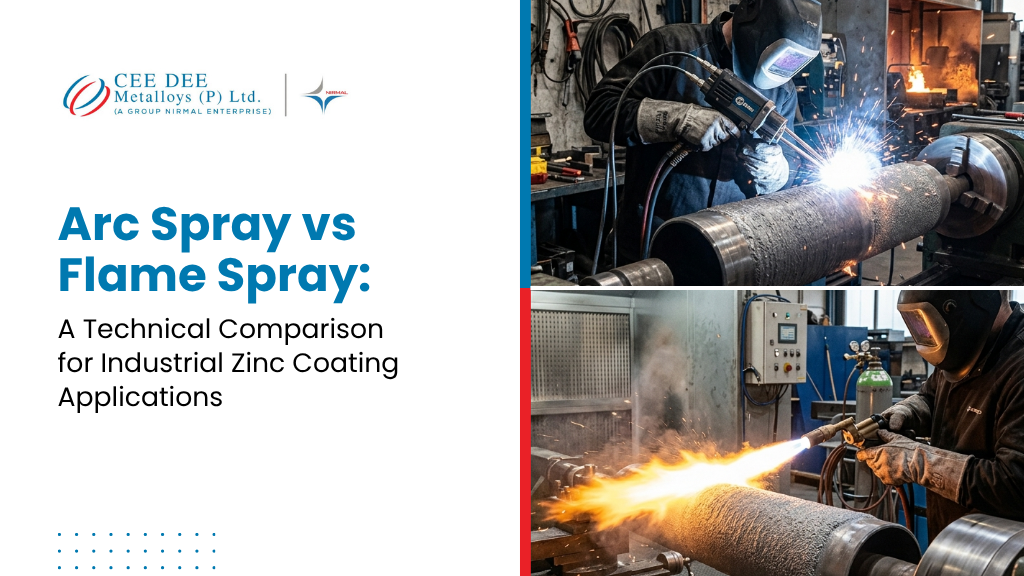
Arc spray, also known as twin-wire arc spray or electric arc spray, is a thermal spray process in which two electrically conductive metallic wires are fed continuously into a spray gun where they are brought together at a controlled angle and a DC electric arc is struck between their tips. The arc, which operates at 18-32 volts and 100-400 amperes depending on the gun model and wire composition, generates enough heat to instantaneously melt the wire tips into fine droplets. A high-velocity compressed air or gas stream then atomises and propels these molten droplets at velocities of 100-200 metres per second onto the prepared substrate, where they flatten into overlapping splats and rapidly solidify to form a dense, mechanically bonded coating.
History of Arc Spray
Arc spray technology was developed in the early 20th century and has continuously evolved since the 1960s with the introduction of solid-state power electronics, improved gun designs, and digital process control. The history of metallizing shows that arc spray became the dominant industrial process for large-scale zinc corrosion protection projects by the 1980s, particularly in offshore, marine, and bridge applications.
Arc spray can only be used with electrically conductive wire feedstocks. This makes it compatible with zinc, zinc-aluminium, tin-zinc, and most other metallic wire feedstocks used in corrosion protection, but excludes ceramic or composite feedstocks that require plasma or HVOF processes.
2. What Is Flame Spray?
Flame spray, also called wire flame spray or combustion wire spray, is a thermal spray process that uses oxy-fuel combustion (typically oxy-acetylene or oxy-propane) to create a flame of sufficient temperature to melt a single metal wire feedstock. The wire is fed continuously into the flame zone, where it is melted and then atomised by a concentric compressed air jet into fine molten particles that are propelled onto the substrate at velocities of 40-100 metres per second.
The lower particle velocity relative to arc spray is the primary physical reason for the differences in coating quality between the two processes. Lower velocity means less impact deformation of arriving droplets, which results in larger inter-splat porosity and lower adhesion strength. However, flame spray has the distinct advantage of mechanical simplicity: the only utilities required are oxy-fuel gas supply, a compressed air source, and the gun itself, with no electrical infrastructure needed.
Fuel Gas Options
Oxy-acetylene flame spray produces the highest flame temperature (approximately 3,200 degrees C) and is best for higher-melting-point feedstocks. Oxy-propane flames at approximately 2,800 degrees C are widely used for zinc and zinc-aluminium wire because the lower temperature is sufficient to melt zinc (melting point 419 degrees C) and the fuel gas is more widely available and safer to handle than acetylene in many regions of India.
3. Coating Quality: A Technical Comparison
The most important performance differentiator between arc spray and flame spray coatings for zinc feedstocks is coating quality, defined in terms of adhesion strength, porosity, oxide content, and hardness. These properties directly determine the corrosion protection life and mechanical durability of the applied coating.
Adhesion Strength
Adhesion to the substrate is a critical quality parameter measured by pull-off testing per ISO 4624. Arc spray zinc coatings consistently achieve adhesion values of 6-10 MPa on Sa 2.5 blast-cleaned steel. Flame spray zinc coatings typically fall in the range of 3.5-6 MPa. The higher particle velocity in arc spray produces greater mechanical interlocking with the substrate anchor profile, which explains the adhesion advantage. Minimum acceptable adhesion for structural corrosion protection is 3.5 MPa per ISO 2063.
Porosity
Porosity in thermally sprayed coatings creates pathways for electrolyte penetration that reduce both barrier and galvanic protection performance. Arc spray zinc coatings typically exhibit 5-10% porosity on cross-section metallographic analysis. Flame spray zinc coatings show 10-18% porosity under equivalent spray conditions. The use of penetrating sealants closes open porosity in both coating types, but starting with lower porosity from arc spray provides an inherent advantage in aggressive environments.
Oxide Content
As molten zinc droplets travel through the air from gun to substrate, they oxidise and form zinc oxide on their surfaces. In arc spray, the shorter flight time and higher velocity mean particles spend less time in the oxidising atmosphere, resulting in lower inter-splat oxide content. In flame spray, the slower particle velocity means longer atmospheric exposure and higher oxide content in the coating. Elevated oxide content reduces coating ductility and galvanic performance.
Upgrade Your Spray System with CeeDee Metalloys Equipment
Our zinc metallizing spray machines are engineered for reliable, consistent arc spray and flame spray performance. Available for purchase and with full technical support across India.
Explore Metallizing Spray Machines4. Equipment Investment and Operating Economics
The economic comparison between arc spray and flame spray systems is more nuanced than simply comparing capital costs. A complete lifecycle economic analysis must account for equipment cost, installation, utilities, maintenance, feedstock consumption, productivity, and coating quality outcomes.
Capital Equipment Cost
A complete flame spray setup for zinc wire consists of the gun, wire feed unit, oxy-fuel regulators, hoses, and a compressed air source. Total capital investment is relatively modest and the equipment is straightforward to procure, transport, and operate. A comparable arc spray setup requires a gun, control console, DC power source (rectifier), wire feed unit, compressed air source, and cables, representing a significantly higher capital investment. However, the productivity advantage of arc spray means that on high-volume projects the additional capital is recovered quickly through reduced operating hours.
Deposition Efficiency and Feedstock Cost
Deposition efficiency is the percentage of feedstock wire that is incorporated into the applied coating rather than lost as overspray. Arc spray achieves 70-85% deposition efficiency for zinc wire. Flame spray achieves 50-65%. On a project consuming 500 kg of zinc wire, arc spray produces approximately 150-175 kg more coating per tonne of feedstock purchased, directly reducing material cost. When zinc wire and zinc-aluminium wire feedstock costs are significant project line items, this efficiency difference is material to the overall budget.
5. Industry Applications and Best-Fit Scenarios
The choice between arc spray and flame spray is often driven by the nature, scale, and location of the project as much as by coating quality requirements. Both processes have well-established application domains where they represent the optimal solution.
Arc Spray Best-Fit Applications
Large infrastructure projects including bridge metallizing, port facility steelwork, wind turbine towers, railway structures, and shipyard fabrication are natural arc spray applications due to the high coating volumes involved and the availability of electrical power at these sites. Arc spray is also preferred for workshop or controlled-environment application where the productivity and consistency advantages can be fully realised. The offshore oil and gas sector uses arc spray systems for zinc-aluminium coating of platform structural members and pipeline risers.
Flame Spray Best-Fit Applications
Remote field maintenance projects where electrical power is unavailable or unreliable are the natural domain for flame spray. Maintenance of rural bridges, isolated storage tanks, agricultural structures, and small-batch fabrication work are situations where flame spray’s simplicity and portability make it the practical choice. Flame spray is also common for repair coating work where the spray area is small and the overhead of setting up arc spray equipment cannot be justified. See the full range of applications for both process types.
6. Feedstock Compatibility: Zinc and Zinc-Aluminium Wires
Both arc spray and flame spray are compatible with the full range of zinc-based thermal spray wire feedstocks, including pure zinc wire, zinc-aluminium wire (ZnAl4 and ZnAl15), and tin-zinc wire. However, each feedstock-process combination requires specific parameter settings to achieve optimum coating quality.
Zinc Wire in Arc Spray
Pure zinc wire is the most straightforward feedstock for arc spray systems. Its low melting point (419 degrees C) and high electrical conductivity make it easy to melt consistently at moderate arc voltages (18-22V). Wire diameters of 3.17mm (1/8 inch) are most common for zinc wire arc spray, though 2.34mm and 4.76mm diameters are used on specialised equipment. The metallizing spray machine systems available from CeeDee Metalloys are pre-configured for zinc wire arc spray and can also be reconfigured for zinc-aluminium wire with minor adjustment.
Zinc-Aluminium Wire in Both Processes
Zinc-aluminium wire presents slightly more demanding melting requirements than pure zinc wire because the aluminium phase has a higher melting point (660 degrees C). In arc spray, this is managed by increasing arc voltage slightly to 22-28V. In flame spray, the fuel-to-oxygen ratio must be adjusted towards a slightly oxidising flame to ensure complete melting of the aluminium phase. Incompletely melted ZnAl particles create hard inclusions in the coating that reduce cohesive strength.
Tin-Zinc Wire Compatibility
Tin-zinc wire is compatible with both arc spray and flame spray processes. The low melting point of tin (231 degrees C) means the alloy is particularly easy to melt in flame spray, making flame spray a practical process choice for tin-zinc coating applications. Learn more about tin-zinc wires for industrial coatings.
7. Niche Applications for Each Process
Automated Arc Spray in Workshop Production
Robotic and automated arc spray systems are used in manufacturing environments for consistent, high-throughput coating of structural members, pipe sections, and fabricated assemblies. Automation eliminates operator variability, improves consistency, and significantly increases production rates, making arc spray the preferred process for modern workshop-based metallizing operations.
Flame Spray for Repair and Maintenance
The portability of flame spray equipment makes it ideal for in-situ maintenance and repair of existing coatings. A technician can carry a complete flame spray kit to a remote site in a vehicle and begin coating within minutes of arrival. This is not practical with arc spray equipment, which requires a power source and additional infrastructure. For maintenance of zinc rod anodes and other sacrificial components in remote installations, flame spray is often the only practical application method.
8. How to Choose Between Arc Spray and Flame Spray
The following comparison table provides a structured reference for the key decision criteria between arc spray and flame spray for zinc-based coating applications.
| Parameter | Arc Spray | Flame Spray |
|---|---|---|
| Energy source | DC electric arc (18-32V, 100-400A) | Oxy-fuel combustion |
| Particle velocity (m/s) | 100-200 | 40-100 |
| Coating adhesion (MPa) | 6-10 | 3.5-6 |
| Coating porosity (%) | 5-10 | 10-18 |
| Deposition efficiency (%) | 70-85 | 50-65 |
| Deposition rate (kg/hr zinc) | 8-15 | 3-6 |
| Equipment capital cost | Higher | Lower |
| Portability | Moderate | High |
| Power supply required | Yes (electrical) | No (oxy-fuel only) |
| Best for large projects | Yes | Less optimal |
| Best for remote/field repair | Possible with generator | Yes |
| Zinc-aluminium wire compatible | Yes (preferred) | Yes (with care) |
9. Best Practices for Both Processes
Regardless of which process is selected, the following best practices govern coating quality and long-term corrosion performance for all thermal spray zinc and zinc-aluminium applications.
Surface Preparation
Sa 2.5 abrasive blast cleaning to ISO 8501-1, with an anchor profile of 50-100 micrometres Rz, is mandatory for both arc spray and flame spray zinc coatings. The substrate must be dry, free of oil, grease, and chloride contamination, and coated within 4 hours of blasting. This single requirement has more influence on long-term coating performance than any other process variable. Guidance on surface preparation specifications is available through the CeeDee Metalloys quality assurance programme.
Process Parameter Control
For arc spray: maintain consistent arc voltage, wire feed rate, air pressure, and stand-off distance throughout the spray operation. Monitor feedstock wire tension and spooling to prevent wire snag that causes arc interruption. For flame spray: maintain consistent fuel-to-oxygen ratio, wire feed rate, and stand-off distance. Regularly inspect the nozzle and air cap for wear or zinc build-up that changes the spray pattern.
Sealing
Apply a penetrating sealant immediately after thermal spray application and before any surface contamination occurs. Inorganic zinc silicate sealers are the standard specification for atmospheric exposure. Low-viscosity epoxy sealers are preferred for immersed or splash zone applications. Sealing can improve coating service life by 30-50% regardless of which spray process was used.
External References
The AWS C2.18 standard provides detailed guidance on thermal spray zinc coating specification and application. The ISO 2063 standard is the definitive international reference for zinc thermal spray coating requirements. NACE International publishes application guidelines for offshore and marine coating specifications. The Society for Protective Coatings (SSPC) publishes SSPC-CS 23.00, which specifies thermal spray coating requirements for North American structural steel projects. The TWI conducts independent research on thermal spray process optimisation.
Key Takeaways
- Arc spray delivers superior coating quality (adhesion, porosity, density) compared with flame spray for zinc and zinc-aluminium wire feedstocks.
- Flame spray offers lower equipment cost, higher portability, and greater suitability for remote or small-scale applications.
- Deposition efficiency of 70-85% for arc spray vs 50-65% for flame spray creates a significant feedstock cost difference on large projects.
- Both processes are compatible with zinc wire and zinc-aluminium wire, subject to appropriate parameter adjustment.
- Arc spray productivity (8-15 kg/hr) is 2-3x that of flame spray (3-6 kg/hr), making it the more economic choice for large coating areas.
- Surface preparation quality overrides process choice as the primary determinant of long-term corrosion performance.
- Sealing of both arc spray and flame spray zinc coatings is strongly recommended for C3 and above corrosivity environments.
10. CeeDee Metalloys: Equipment and Feedstock Across India
- Zinc Metallizing Spray Machine Manufacturers in Delhi
- Zinc Metallizing Spray Machine Manufacturers in Uttar Pradesh
- Zinc Metallizing Spray Machine Manufacturers in Gujarat
- Zinc Metallizing Spray Machine Manufacturers in Haryana
- Zinc Metallizing Spray Machine Manufacturers in Rajasthan
- Zinc Metallizing Spray Machine Manufacturers in Kolkata
- Zinc Metallizing Spray Machine Manufacturers in Raipur
- Zinc Metallizing Spray Machine Manufacturers in Odisha
11. Related Reading
Frequently Asked Questions
What is the primary difference between arc spray and flame spray for zinc coatings?
Arc spray uses an electric arc to melt two conductive wires, producing a hotter, more energetic spray with higher particle velocity, lower porosity, and better adhesion. Flame spray uses oxy-fuel combustion to melt a single wire, offering lower equipment cost and greater portability but with lower deposition efficiency and slightly higher porosity in the resultant coating.
Which process produces a better quality zinc coating: arc spray or flame spray?
Arc spray consistently produces higher quality zinc and zinc-aluminium coatings in terms of adhesion strength, coating density, and lower porosity. Typical arc spray adhesion values for zinc are 6-10 MPa compared with 3.5-6 MPa for flame spray. For critical corrosion protection in C4-C5 environments, arc spray is generally preferred. Flame spray coatings can meet minimum specifications when applied correctly and are perfectly adequate for many C1-C3 applications.
Is arc spray equipment more expensive than flame spray equipment?
Yes. Arc spray systems require a rectifier power source, control unit, and specialised gun in addition to the air compressor, resulting in a higher capital investment. Flame spray equipment requires only a gun, wire feed, and oxy-fuel gas supply, making it considerably less expensive to procure and simpler to set up in remote locations. The higher deposition efficiency of arc spray partially offsets the higher equipment cost over time through lower feedstock consumption.
Can flame spray be used to apply zinc-aluminium wire?
Yes, flame spray can be used with zinc-aluminium wire. However, operators must carefully adjust the flame to ensure complete melting of both the zinc and aluminium phases. Incompletely melted particles in the coating reduce density and corrosion performance. Arc spray is generally more reliable for zinc-aluminium alloy wires because the arc temperature is higher and less sensitive to compositional variation.
What deposition rate can be achieved with arc spray zinc wire?
Production arc spray systems can deposit zinc wire at rates of 8-15 kg/hour depending on wire diameter, current settings, and gun design. Automated arc spray systems can achieve even higher rates. Flame spray deposition rates are typically 3-6 kg/hour for zinc wire, making arc spray approximately 2-3x more productive per hour of operation.
Which process is better for field application on large structures?
Flame spray has historically been favoured for remote field applications because of the simpler equipment setup and independence from electrical power supply. However, modern compact arc spray systems with generator-compatible rectifiers have made arc spray increasingly viable for field use. For large volume field projects such as bridge recoating, arc spray is now the preferred process due to its higher productivity and consistent coating quality.
Does the spray process affect the corrosion performance of the zinc coating?
Yes, significantly. Arc spray zinc coatings typically show 20-30% lower porosity than equivalent flame spray coatings and 30-50% higher adhesion values. In standardised salt spray testing, arc spray zinc coatings consistently achieve longer protection times at the same coating thickness. The process also affects oxide content: arc spray coatings typically have lower inter-splat oxide content, contributing to better galvanic performance.
What safety considerations apply to arc spray vs flame spray operations?
Both processes generate zinc fume, which requires respiratory protection, ventilation controls, and blood zinc level monitoring. Flame spray additionally involves oxy-fuel gas cylinders, creating fire and explosion risk that requires strict gas storage and handling protocols. Arc spray involves high electrical current and requires appropriate electrical safety precautions. Both processes generate metallic overspray that requires containment and appropriate personal protective equipment.