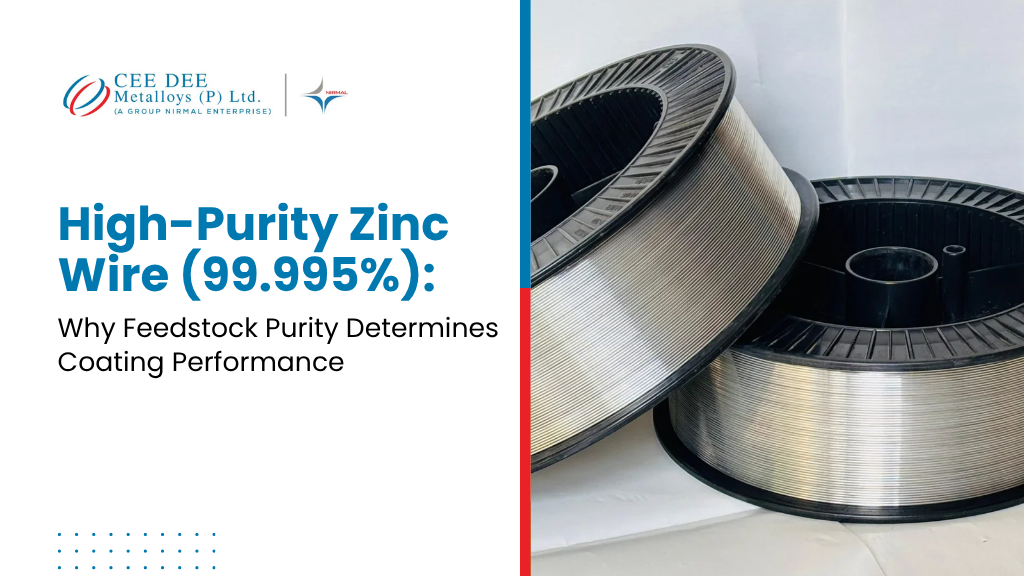
- 99.995% purity (Special High Grade) is the internationally recognised minimum standard for zinc wire used in structural thermal spray corrosion protection.
- Lead contamination above 0.003% in zinc feedstock creates brittle grain boundary phases that reduce coating cohesive strength and accelerate corrosion.
- Cadmium, iron, and copper are the other critical impurity elements, each with specific effects on coating microstructure and electrochemical performance.
- Material Test Reports (MTRs) from the wire manufacturer are the primary quality assurance tool for incoming feedstock verification.
- ISO 752 and ASTM B6 are the governing standards for zinc ingot purity; ASTM B833 covers the finished wire product specification.
- Whole-project economics strongly favour paying for certified high-purity feedstock over coating system failure caused by substandard wire.
- What Is Special High Grade (SHG) Zinc Wire?
- How Feedstock Purity Affects Coating Formation
- The Role of Specific Impurity Elements
- Purity vs Coating Performance: The Data
- Industry Applications Where Purity Is Non-Negotiable
- Commercial Zinc Grades and Why Most Are Unsuitable
- Specialty Purity Requirements: Electronics and EMC Applications
- How to Qualify a Zinc Wire Supplier on Purity
- Incoming Inspection and Storage Best Practices
- CeeDee Metalloys: Certified Zinc Wire Across India
- Related Reading
- Frequently Asked Questions
Of all the variables that determine the long-term performance of a thermally sprayed zinc coating, feedstock wire purity is arguably the most controllable and the most frequently underspecified. Engineers devote considerable attention to surface preparation standards, spray parameters, coating thickness, and sealant selection, yet the chemical composition of the zinc wire itself can silently undermine all of these investments if substandard feedstock enters the coating system.
CeeDee Metalloys manufactures zinc wire to the Special High Grade (SHG) 99.995% purity standard as the baseline specification for all thermal spray feedstock supply. This article explains in technical detail why this purity level matters, what happens to coating performance when impurity levels creep above specification, and how procurement and quality teams can verify that the zinc wire arriving on their projects meets the standard that the coating system specification demands.
1. What Is Special High Grade (SHG) Zinc Wire?
Special High Grade (SHG) zinc is the highest standard commercial purity grade for zinc metal, defined by a minimum zinc content of 99.995% and a maximum total impurity content of 50 parts per million (ppm). This designation originates from the London Metal Exchange (LME) and ISO 752 classification system for zinc ingots, which categorises zinc into four grades based on impurity levels: Special High Grade, High Grade, Intermediate, and Prime Western, with SHG being the purest.
When drawn into wire form, SHG zinc is processed through a series of drawing dies that reduce the ingot cross-section to the target diameter while maintaining the chemical integrity of the starting material. The drawing process does not alter zinc purity, but it can introduce surface contamination from lubricants if drawing oils are not completely removed before final annealing. Reputable wire manufacturers like CeeDee Metalloys include a degreasing and cleaning step in the production process to ensure surface contamination does not compromise the sprayed coating.
SHG zinc at 99.995% purity should not be confused with “four nines” zinc (99.99%), which is a different and slightly less pure grade. The difference of 0.005% may appear trivial, but at the trace element level it can represent a 100% difference in lead content between compliant and non-compliant wire. Always verify the purity specification to the fifth decimal place.
Governing Standards
The chemical composition of zinc wire for thermal spray is governed by ISO 752 (Zinc Alloys: Chemical Composition and Forms of Deliverable Products) for the international market and ASTM B6 (Standard Specification for Zinc) for North America. The finished wire product specification, including dimensional tolerances and mechanical properties in addition to chemical composition, is covered by ASTM B833 (Standard Specification for Zinc and Zinc-Alloy Wire for Thermal Spraying). The thermal spray coating specification standards ISO 2063 and EN ISO 14713 reference SHG zinc wire as the required feedstock grade for structural corrosion protection coatings.
2. How Feedstock Purity Affects Coating Formation
To understand why feedstock purity matters, it is necessary to consider what happens to impurity elements during the thermal spray process. When zinc wire is melted in an arc spray or flame spray gun and propelled onto the substrate, the impurity elements present in the wire are incorporated into the molten droplets and subsequently into the solidified coating splats. Unlike casting or galvanising processes, thermal spray does not provide an opportunity for impurity segregation or separation during solidification, because the splat cooling rate is extremely high (10^5 to 10^7 degrees C per second). Impurities are effectively locked into the coating matrix in whatever distribution they existed in the feedstock wire.
Impurity Distribution in the Coating
The behaviour of impurity elements in thermally sprayed zinc coatings depends on their metallurgical relationship with zinc. Lead, for example, is nearly insoluble in solid zinc and segregates to splat boundaries and inter-splat interfaces during the rapid solidification process, forming a continuous network of lead-rich phases at the boundaries between zinc splats. This network creates preferential pathways for electrolyte penetration and galvanic corrosion that are invisible to standard coating inspection methods but profoundly degrade long-term corrosion resistance.
Iron forms hard intermetallic FeZn phases that act as stress concentration points within the coating, reducing ductility and creating initiation sites for cohesive cracking under mechanical loading. Copper reduces the electrochemical potential of the zinc coating, diminishing its galvanic protection advantage over the steel substrate. Each impurity element has a specific mechanism of degradation, making overall purity control essential rather than control of any single element in isolation.
3. The Role of Specific Impurity Elements
The following analysis covers the four impurity elements of greatest practical significance for thermal spray zinc coating performance: lead, cadmium, iron, and copper.
Lead (Pb)
Lead is the most consequential impurity element in zinc wire for thermal spray. Under ISO 752, SHG zinc permits a maximum of 0.003% (30 ppm) lead. Prime Western zinc, by contrast, permits up to 1.6% lead. At concentrations above 0.005%, lead begins to form visible grain boundary phases in the sprayed coating microstructure. Research published by the International Zinc Association demonstrates that increasing lead content from 0.003% to 0.1% reduces salt spray life of a 200-micrometre zinc coating by approximately 35-40%, entirely due to the formation of preferential corrosion pathways at lead-enriched splat boundaries.
Lead in zinc coatings also has significant regulatory implications. During future maintenance operations involving abrasive blasting or power tool cleaning of the coated surface, lead-containing dust and debris are generated. If the coating lead content exceeds regulatory thresholds (typically 0.1% by weight under European REACH and equivalent Indian standards), the waste must be classified as hazardous, dramatically increasing disposal costs and requiring licensed contractor involvement. Specifying SHG zinc wire eliminates this liability entirely.
Cadmium (Cd)
Cadmium is permitted to a maximum of 0.003% (30 ppm) under ISO 752 for SHG zinc. Cadmium is a cumulative toxic heavy metal with strict occupational exposure limits and environmental regulations. In thermal spray operations, cadmium-containing zinc fume is generated during melting and atomisation. While the absolute cadmium mass in SHG zinc wire is negligible, lower-purity feedstock from unverified sources may contain significantly elevated cadmium, creating occupational health and environmental compliance risks that far exceed the cost savings from cheaper feedstock.
Iron (Fe)
Iron is controlled to a maximum of 0.003% (30 ppm) in SHG zinc. Iron contamination in zinc wire typically originates from the smelting process or from contact with steel equipment during drawing. Iron forms hard FeZn intermetallic compounds in the coating that reduce ductility and create stress concentration sites. High iron content also causes drawing difficulties, increasing the risk of wire breakage during production and contributing to surface defects that affect spooling and feed consistency in arc spray systems.
Copper (Cu)
Copper is limited to 0.001% (10 ppm) in SHG zinc. Even small additions of copper shift the electrochemical potential of the zinc coating in the positive (noble) direction, reducing the galvanic driving force that makes zinc a sacrificial protector for steel. A zinc coating with 0.05% copper content may show adequate barrier protection in salt spray testing but will fail to provide effective cathodic protection at holidays and damaged areas in service, undermining the fundamental protection mechanism of the coating system.
4. Purity vs Coating Performance: The Data
The quantitative relationship between zinc wire purity and coating corrosion performance is well established in the published literature and industry standards. The following data points represent the consensus of salt spray testing and field performance data compiled by standards bodies and industry research organisations.
Salt Spray Performance
Standardised salt spray testing per ASTM B117 and ISO 9227 at 5% NaCl solution provides comparative data on coating purity effects. Arc-sprayed coatings from SHG 99.995% zinc wire at 200 micrometres dry film thickness (DFT) consistently achieve 2,500-3,500 hours to first visible rust. Equivalent coatings from 99.9% purity zinc wire (allowing up to 0.1% total impurities) typically show first rust at 1,800-2,400 hours, a 25-30% reduction in service life for what appears to be a minor purity difference.
Adhesion Strength
Pull-off adhesion testing per ISO 4624 on coatings from SHG vs lower-purity zinc wire consistently shows that SHG coatings achieve adhesion values at or above 6 MPa in arc spray, while coatings from zinc wire with elevated lead content (above 0.05%) show adhesion values 15-25% lower at equivalent spray parameters. The mechanism is the lead-enriched inter-splat boundary network, which creates a plane of weakness within the coating rather than at the substrate interface.
5. Industry Applications Where Purity Is Non-Negotiable
Certain industry sectors and application types have zero tolerance for substandard feedstock purity, either because of the severity of the service environment, the regulatory framework governing the application, or the consequences of premature coating failure.
Offshore Oil and Gas
Offshore platform structural members, subsea pipelines, and topside equipment in hydrocarbon processing environments represent the highest-consequence applications for thermal spray zinc coatings. International offshore standards including NORSOK M-501 specify SHG zinc wire by name for metallising applications and require feedstock certification as part of the coating procedure qualification documentation. Coating failure on an offshore structure can result in accelerated corrosion of structural members with safety implications that dwarf the cost of premium feedstock.
Bridge and Civil Infrastructure
Major bridge metallising projects in India and internationally are specified to ISO 2063 or equivalent national standards, all of which require SHG zinc wire feedstock. The long design service lives of bridge structures (60-120 years) mean that even a 20% reduction in coating service life from substandard feedstock compounds significantly over the full maintenance cycle, turning what appeared to be a procurement saving into a long-term liability. The applications portfolio of CeeDee Metalloys includes bridge and civil infrastructure metallising across India.
Defence and Government Contracts
Defence procurement specifications for thermal spray zinc coatings universally require SHG feedstock with material certification, and contracts typically include provisions for third-party feedstock testing. Government infrastructure projects under Indian standards BIS and equivalent bodies similarly require certified SHG zinc wire with full traceability documentation.
Certified SHG Zinc Wire with Full MTR Documentation
CeeDee Metalloys supplies 99.995% purity zinc wire backed by chemical analysis certificates, material test reports, and ISO-compliant traceability. Contact us for project-specific certification requirements.
Request Certification Details6. Commercial Zinc Grades and Why Most Are Unsuitable for Thermal Spray
The zinc market offers several commercial purity grades that are used across different industries. Understanding where thermal spray feedstock sits in this hierarchy is important for procurement teams that may encounter lower-cost alternatives from non-specialist suppliers.
| Zinc Grade | Min Purity (%) | Max Lead (ppm) | Thermal Spray Suitable? | Typical Use |
|---|---|---|---|---|
| Special High Grade (SHG) | 99.995 | 30 | Yes (required) | Thermal spray, die casting alloys |
| High Grade (HG) | 99.99 | 100 | Marginal (not specified) | Galvanising, brass production |
| Intermediate | 99.5 | 1,400 | No | General galvanising |
| Prime Western | 98.0 | 16,000 | No | Galvanising, alloying |
The table above makes clear that only SHG zinc at 99.995% meets the feedstock specification for thermal spray corrosion protection coatings. High Grade zinc at 99.99% has a lead allowance 3.3 times higher than SHG and is not specifically referenced in thermal spray coating standards. While it may produce acceptable coatings in some circumstances, it cannot be guaranteed to meet coating performance specifications and should be rejected in favour of confirmed SHG material.
7. Specialty Purity Requirements: Electronics and EMC Applications
Beyond structural corrosion protection, thermal spray zinc coatings are used in electronics and electromagnetic compatibility (EMC) applications where purity requirements may be even more stringent than the structural corrosion protection standard.
Electromagnetic Shielding Coatings
Zinc coatings applied to electronic enclosures, EMC chambers, and MRI facility walls for electromagnetic shielding effectiveness (SE) require high electrical conductivity. Impurity elements, particularly iron and copper, increase the electrical resistivity of the zinc coating and reduce shielding effectiveness at high frequencies. For EMC applications requiring SE above 60 dB at frequencies above 1 GHz, SHG zinc wire at 99.995% is the minimum acceptable feedstock specification. Learn more about the use of zinc in electronics and the specific requirements for electronic applications.
Capacitor Metallisation
While not a thermal spray application, the zinc metallisation used in film capacitors also requires ultra-high purity zinc to maintain consistent electrical performance and long service life. The same purity principles apply across all zinc metallisation technologies: impurities compromise the functional properties of the metal film. The tin-zinc wire formulations used in capacitor metallisation applications similarly require tightly controlled composition. See also: tin-zinc wires for industrial coatings.
8. How to Qualify a Zinc Wire Supplier on Purity
Supplier qualification for zinc wire purity is a structured process that should be conducted before placing the first order and periodically throughout the supply relationship. The following framework covers the key qualification steps that procurement and quality teams should apply.
Documentation Review
Request and review the supplier’s material test report (MTR) format and verify that it covers all required elements: zinc content, lead, cadmium, iron, copper, and tin as a minimum. Confirm that analysis is performed by a recognised analytical method (ICP-OES or XRF) and that results are traceable to specific production batches. Verify that the supplier references ISO 752, ASTM B6, or equivalent standard as the basis for the chemical specification. The quality assurance documentation from CeeDee Metalloys covers all of these requirements as standard.
First Article Inspection
For new supplier qualification or when changing from one supplier to another, conduct third-party chemical analysis of the first article sample from the prospective supplier using an independent certified laboratory. Compare the results against the MTR provided by the supplier. Discrepancies between the supplier’s MTR and independent analysis results are a serious quality system concern and should trigger a formal supplier corrective action request before proceeding with the supply relationship.
Periodic Re-qualification
Even for established and trusted suppliers, periodic independent re-qualification testing provides assurance that feedstock purity is maintained over time. Annual re-qualification is a reasonable frequency for high-volume supply relationships. For critical projects, batch-by-batch MTR review with periodic third-party verification provides the highest level of assurance.
9. Incoming Inspection and Storage Best Practices
Even with a qualified supplier providing certified SHG zinc wire, incoming inspection and proper storage practices are necessary to maintain the integrity of the feedstock from delivery to point of use.
Incoming Inspection Checklist
On receipt of each zinc wire delivery, the following inspection steps should be completed before the material is accepted into stores. First, verify that the MTR accompanying the shipment matches the batch number marked on the spool labels and corresponds to the purchase order specification. Second, conduct a visual inspection of the wire surface for evidence of oxidation, mechanical damage, oil contamination, or kinking. Third, check the spool dimensions against the wire feed unit specification. Fourth, measure the wire diameter at multiple points across the spool and confirm it falls within the specified dimensional tolerance. Any non-conformance should trigger a formal hold and supplier notification before the material is used.
Storage Requirements
Store zinc wire spools in dry, ventilated conditions at temperatures between 10 and 35 degrees C. Avoid storage near acids, chlorinated solvents, or ammonia-containing compounds that can cause rapid surface attack on zinc. Maintain stock rotation on a first-in, first-out basis and observe the manufacturer’s recommended maximum storage period (typically 18 months for SHG zinc wire in appropriate storage conditions). Wire that has been in storage for longer than the recommended period should be re-inspected and surface oxide should be removed by light mechanical cleaning before use.
External Standards and References
The ISO 752 standard provides the definitive specification for zinc metal purity grades. ASTM B6 is the North American equivalent. ASTM B833 covers the finished zinc wire product specification including dimensional tolerances. The International Zinc Association publishes guidance on zinc feedstock quality for thermal spray. NACE International SP0215 and the Society for Protective Coatings SSPC-CS 23.00 reference SHG zinc feedstock in their thermal spray coating specifications.
Key Takeaways
- 99.995% SHG zinc wire is the mandatory feedstock specification for thermal spray structural corrosion protection coatings under ISO 2063 and EN ISO 14713.
- Lead contamination above 0.003% is the most damaging impurity, forming grain boundary phases that reduce adhesion and accelerate corrosion by 25-40%.
- Cadmium, iron, and copper each have specific degradation mechanisms: cadmium raises occupational health risk; iron reduces ductility; copper reduces galvanic protection.
- The price premium for SHG zinc wire over lower grades is 3-8% per kilogram, representing an insignificant fraction of total coating system cost.
- Material Test Reports with ICP-OES chemical analysis, batch traceability, and reference to ISO 752 or ASTM B6 are the minimum documentation requirement for feedstock qualification.
- Independent third-party verification testing is recommended for first article qualification of new suppliers and periodically throughout supply relationships.
- Proper storage in dry, clean conditions and first-in, first-out rotation preserves feedstock quality from delivery to application.
10. CeeDee Metalloys: Certified Zinc Wire Across India
- Zinc Wire Manufacturers in Delhi
- Zinc Wire Manufacturers in Uttar Pradesh
- Zinc Wire Manufacturers in Gujarat
- Zinc Wire Manufacturers in Haryana
- Zinc Wire Manufacturers in Rajasthan
- Zinc Wire Manufacturers in Kolkata
- Zinc Wire Manufacturers in Raipur
- Zinc Wire Manufacturers in Odisha
- Zinc Wire Manufacturers in Gurgaon
11. Related Reading
Frequently Asked Questions
What does 99.995% purity mean for zinc wire?
99.995% purity means that at least 999.95 parts per thousand of the wire composition is pure zinc. The remaining 0.005% (50 parts per million) represents the maximum combined allowance for all impurity elements including lead, cadmium, iron, copper, and tin. This grade is known as Special High Grade (SHG) zinc and is the internationally recognised standard for thermal spray feedstock wire used in structural corrosion protection.
Why does lead contamination in zinc wire harm coating performance?
Lead forms brittle intermetallic compounds at zinc grain boundaries during solidification of the sprayed coating. These compounds reduce coating cohesive strength and create preferential corrosion pathways in aggressive environments. Lead also has regulatory implications: coatings containing lead above threshold levels require hazardous waste classification during future maintenance or removal, adding significant project cost and complexity.
Can lower purity zinc wire (99.9% or 99.5%) be used for thermal spray?
Lower purity zinc wire can technically be processed through thermal spray equipment, but the resulting coatings will not meet the performance requirements of ISO 2063, EN ISO 14713, or SSPC-CS 23.00 for structural corrosion protection. For non-critical or decorative applications, lower purity may be acceptable, but for structural steel protection, 99.995% SHG grade is the correct specification without exception.
How can I verify the purity of zinc wire I have purchased?
Purity verification should be based on the material test report (MTR) supplied by the manufacturer with each production batch. The MTR should show chemical analysis results for zinc content and all regulated impurity elements measured by ICP-OES or equivalent method. For high-value projects, independent third-party verification using a certified analytical laboratory provides the highest level of assurance. CeeDee Metalloys provides full MTR documentation with every zinc wire supply batch.
What is the difference between SHG zinc and Prime Western zinc for thermal spray?
Special High Grade (SHG) zinc is 99.995% pure with a maximum total impurity content of 50 ppm. Prime Western zinc is approximately 98% pure, with lead content up to 1.6% and significant iron content. Prime Western zinc is wholly unsuitable for thermal spray coating and will produce coatings with severely degraded corrosion resistance, poor adhesion, and regulatory compliance issues due to lead content.
Does zinc wire purity affect the arc spray process differently from flame spray?
Purity effects on coating quality are essentially the same regardless of spray process, since both incorporate impurities from the feedstock wire directly into the coating matrix. However, impurities that affect wire drawing characteristics (such as iron inclusions) are more likely to cause wire feed inconsistency in arc spray systems, where tight dimensional tolerances are required for stable arc formation. Flame spray is slightly more tolerant of minor feedstock variations in this respect.
Is cadmium a concern in thermal spray zinc wire?
Yes. Cadmium is a regulated toxic heavy metal that must be kept below 0.003% (30 ppm) in SHG zinc wire. Thermal spray operations with cadmium-contaminated feedstock generate cadmium-containing fume that presents a serious occupational health hazard and may trigger regulatory reporting obligations. Reputable zinc wire suppliers maintain cadmium levels well below regulatory limits and document this in the MTR.
What standard governs the purity requirements for zinc used in thermal spray wire?
The primary standards are ISO 752 (Zinc Alloys: Chemical Composition) for the zinc ingot purity specification, ASTM B6 (Standard Specification for Zinc) for the North American market, and ASTM B833 (Standard Specification for Zinc and Zinc-Alloy Wire for Thermal Spraying) which specifies the wire product requirements including dimensional tolerances and mechanical properties in addition to chemical composition.