- Thermally sprayed zinc creates a continuous conductive layer that attenuates electromagnetic waves through reflection, absorption, and multiple internal reflection mechanisms.
- Shielding effectiveness (SE) of 40-60 dB is achievable with 100-200 micrometre zinc coatings across 100 MHz to 1 GHz.
- Arc spray zinc coatings outperform flame spray for EMC applications due to lower porosity and higher coating density.
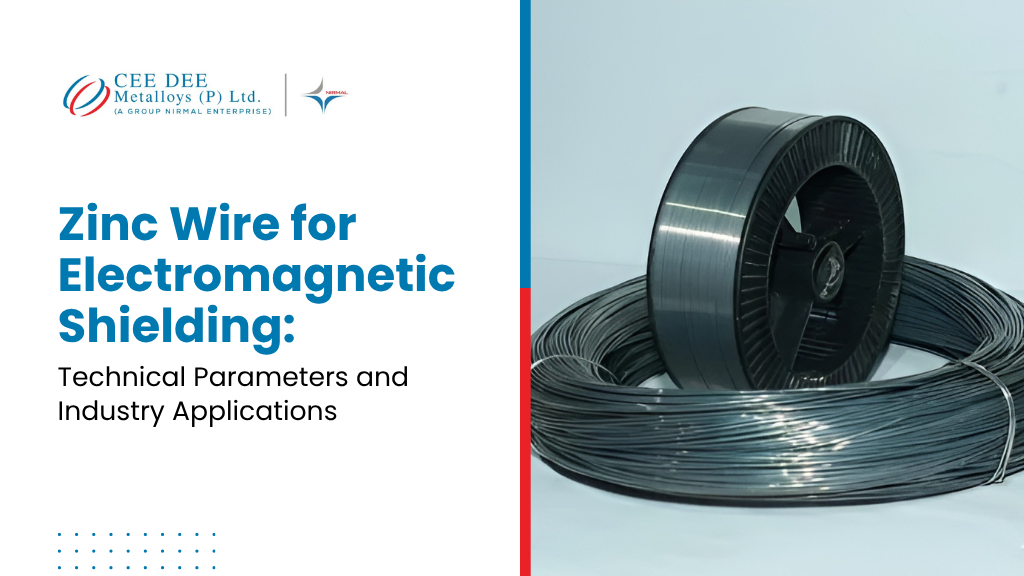
- 99.995% SHG purity zinc wire is required for shielding applications to maintain maximum electrical conductivity.
- Key sectors include electronics enclosures, defence systems, MRI facilities, anechoic chambers, and 5G telecom infrastructure.
- Zinc-aluminium wire offers broadband shielding advantage over pure zinc in applications requiring performance above 1 GHz.
- What Is Electromagnetic Shielding and Why Is It Needed?
- How Thermally Sprayed Zinc Provides Electromagnetic Shielding
- Key Technical Parameters for Zinc EMC Coatings
- Zinc Wire vs Zinc-Aluminium Wire for EMC Applications
- Industry Applications and Sector Breakdown
- Process Selection: Arc Spray vs Flame Spray for EMC Coatings
- Niche and Emerging Shielding Applications
- Selection Guide: When to Choose Thermal Spray Zinc for EMC
- EMC Standards and Testing Protocols
- CeeDee Metalloys Serves Industries Across India
- Related Reading
- Frequently Asked Questions
Electromagnetic interference (EMI) and electromagnetic compatibility (EMC) have become critical engineering concerns across virtually every industrial sector. From consumer electronics and medical devices to defence systems and 5G telecommunications infrastructure, the ability to control electromagnetic fields is as important as corrosion protection or mechanical strength in many modern applications. Thermally sprayed zinc wire coatings offer a technically compelling and commercially scalable solution for electromagnetic shielding on a wide range of substrate materials and structure types.
This guide from CeeDee Metalloys covers the physics of zinc coating electromagnetic shielding, the technical parameters that govern shielding performance, the industries where thermal spray zinc shielding is deployed, and the selection criteria for choosing between zinc wire and zinc-aluminium wire for specific EMC applications. It builds on our broader coverage of the use of zinc in electronics with a focused technical treatment of the shielding effectiveness topic.
1. What Is Electromagnetic Shielding and Why Is It Needed?
Electromagnetic shielding is the practice of using conductive or magnetic materials to create a barrier that reduces the transmission of electromagnetic fields between regions of space. The need for shielding arises in two situations: keeping electromagnetic emissions from a source from reaching a sensitive receiver (emissions shielding), and protecting sensitive equipment from external electromagnetic fields (susceptibility shielding). In practice, most shielding applications address both requirements simultaneously.
The global regulatory framework for electromagnetic compatibility has become increasingly stringent. The European Union’s CE marking requirements under the EMC Directive 2014/30/EU, India’s BIS EMC standards (IS/IEC 61000 series), and the US FCC Part 15 and Part 18 regulations all impose mandatory limits on electromagnetic emissions from electronic equipment. Failure to meet these standards can result in product recall, regulatory penalties, and market access prohibition. Effective electromagnetic shielding is therefore not merely a technical preference but a commercial and regulatory necessity for manufacturers of electronic equipment.
Sources of Electromagnetic Interference
Sources of electromagnetic interference include switching power supplies, microprocessors, radio frequency transmitters, electric motors, power transmission lines, and lightning. As electronic systems have become faster and more densely packed, both the frequency range and the amplitude of internally generated interference have increased, demanding better shielding solutions. The rollout of 5G telecommunications infrastructure operating at millimetre-wave frequencies (24-100 GHz) has created new and demanding shielding requirements that were not anticipated in the design of older shielding systems.
Shielding effectiveness (SE) is measured in decibels (dB) and represents the ratio of electromagnetic field strength with and without the shield in place. A 20 dB shield reduces field amplitude to 10% of the unshielded value. A 40 dB shield reduces it to 1%. A 60 dB shield reduces it to 0.1%. Each additional 20 dB represents a tenfold reduction in field amplitude.
2. How Thermally Sprayed Zinc Provides Electromagnetic Shielding
The electromagnetic shielding mechanism of a thermally sprayed zinc coating operates through three overlapping physical processes: reflection, absorption, and multiple internal reflection. Understanding these mechanisms is essential for designing coating systems that meet specific SE targets across defined frequency ranges.
Reflection
When an electromagnetic wave encounters the surface of a conductive material, a portion of the wave energy is reflected back from the surface. The fraction reflected depends on the impedance mismatch between free space and the conductive coating: the lower the coating’s surface impedance (higher conductivity, lower porosity), the greater the reflection. Pure zinc, with an electrical resistivity of approximately 5.9 x 10^-8 ohm metres at room temperature, is a good electrical conductor and provides significant reflection even at low coating thicknesses. Reflection is the dominant shielding mechanism at lower frequencies and is relatively independent of coating thickness once the coating is electrically continuous.
Absorption
Energy that is not reflected at the coating surface penetrates into the coating and is absorbed as the electromagnetic wave induces eddy currents in the conductive matrix. The depth to which the wave penetrates before being effectively attenuated is called the skin depth, which decreases with increasing frequency and increasing electrical conductivity. At 1 GHz, the skin depth in zinc is approximately 3 micrometres, meaning that a 100-micrometre coating provides approximately 33 skin depths of absorption at this frequency, corresponding to very high attenuation. At 1 MHz, the skin depth in zinc is approximately 95 micrometres, meaning that thin coatings below 100 micrometres provide limited absorption at this frequency and reflection becomes the primary mechanism.
Multiple Internal Reflection
Multiple internal reflection is a correction factor that reduces the total SE below the simple sum of reflection and absorption losses, particularly at low frequencies where absorption is limited. For coating thicknesses greater than the skin depth (true at GHz frequencies for zinc coatings above 50 micrometres), the multiple internal reflection correction is negligible. For very thin coatings at low frequencies, multiple internal reflection can significantly reduce the effective SE below the theoretical value.
3. Key Technical Parameters for Zinc EMC Coatings
The shielding effectiveness of a thermally sprayed zinc coating is determined by a set of interacting technical parameters that must be optimised together to achieve the target SE specification.
Electrical Conductivity
Electrical conductivity is the most fundamental determinant of shielding performance. Pure zinc has a bulk conductivity of approximately 16.6 x 10^6 S/m. Thermally sprayed zinc coatings have lower effective conductivity than bulk zinc due to porosity, inter-splat oxide layers, and coating discontinuities. Measured effective conductivity of arc spray zinc coatings is typically 30-60% of the bulk value, corresponding to approximately 5-10 x 10^6 S/m. Impurities (particularly iron and copper) in the feedstock wire further reduce conductivity, reinforcing the case for 99.995% SHG zinc wire as the feedstock for shielding applications.
Coating Thickness
Increasing coating thickness improves shielding effectiveness, particularly at lower frequencies where absorption is the limiting mechanism. The relationship between thickness and SE is not linear: each additional increment of thickness provides diminishing returns as the total absorption exceeds several skin depths. Practical coating thicknesses for EMC applications range from 100 micrometres for general electronics enclosures to 400-500 micrometres for high-SE applications such as anechoic chambers and MRI shielding rooms.
Coating Continuity and Sealing
Electromagnetic waves can penetrate through apertures in a shielding layer that are large compared with the wavelength of the field being shielded. Coating porosity and discontinuities act as such apertures, reducing SE particularly at higher frequencies. Conductive sealants applied over the thermal spray layer close open pores and improve coating continuity, typically improving SE by 5-15 dB depending on the frequency range and the initial coating porosity.
Specify Zinc Wire for Your EMC Shielding Project
CeeDee Metalloys supplies 99.995% SHG zinc wire optimised for thermal spray EMC coating applications. Contact our technical team for feedstock specifications and application guidance.
Discuss Your EMC Requirements4. Zinc Wire vs Zinc-Aluminium Wire for EMC Applications
Both pure zinc wire and zinc-aluminium alloy wire are used in thermal spray electromagnetic shielding applications, each with distinct performance advantages at specific frequency ranges and environmental conditions.
| Parameter | Pure Zinc Wire (99.995%) | Zinc-Aluminium Wire (ZnAl15) |
|---|---|---|
| Electrical conductivity (bulk) | 16.6 x 10^6 S/m | ~14 x 10^6 S/m |
| SE at 100 MHz (200 micrometres) | 45-55 dB | 42-52 dB |
| SE at 1 GHz (200 micrometres) | 55-65 dB | 58-68 dB |
| SE at 10 GHz (200 micrometres) | 60-70 dB | 63-73 dB |
| Coating density (porosity) | 8-15% | 5-10% |
| Corrosion resistance | Good (C1-C3) | Excellent (C3-C5) |
| Preferred frequency range | Below 1 GHz | Above 1 GHz |
| Best for | General EMC enclosures, indoor shielding rooms | High-freq applications, outdoor EMC structures |
The slightly lower electrical conductivity of zinc-aluminium alloy is partially compensated by the lower porosity of the ZnAl coating, which improves coating continuity and reduces aperture losses. At frequencies above 1 GHz, the denser ZnAl coating consistently outperforms pure zinc in shielding effectiveness measurements, making it the preferred choice for 5G infrastructure and millimetre-wave applications. Learn more about zinc-aluminium wire benefits.
5. Industry Applications and Sector Breakdown
Thermal spray zinc coatings for electromagnetic shielding are deployed across a diverse range of industry sectors. The following analysis covers the principal application domains and their specific technical requirements.
Electronics Manufacturing
Electronic equipment enclosures, backplanes, and cable trays are the largest volume application for thermal spray EMC coatings. The transition from metal to plastic enclosures in consumer and industrial electronics has created a major demand for conductive coatings that restore the shielding effectiveness of the original metal housing. Thermal spray zinc provides a robust, low-resistance conductive coating on plastic housing components that meets CE marking requirements for Class B and Class A electronic equipment. Unlike conductive paints, thermal spray zinc coatings are permanent, thermally stable, and do not delaminate or crack under flexing or thermal cycling.
Defence and Military Systems
Military electronics must meet the stringent requirements of MIL-STD-461 (CE102, CS114, RE102, RS103) for electromagnetic compatibility, which require SE values up to 120 dB in some applications. Thermal spray zinc coatings are used as a component of multi-layer shielding systems for military electronics enclosures, vehicle electronics bays, command and control facilities, and aircraft avionic bays. The MIL-STD environment also requires resistance to harsh environmental conditions (salt fog, humidity, fungal growth) where the combination of EMC performance and corrosion resistance of zinc coatings is particularly valuable.
Medical Imaging: MRI Facilities
MRI (Magnetic Resonance Imaging) facilities require radio frequency (RF) shielding rooms that attenuate external RF interference at the Larmor frequency of the specific MRI scanner (typically 64 MHz for 1.5 Tesla, 128 MHz for 3 Tesla, and 300 MHz for 7 Tesla systems). Thermal spray zinc coatings on the walls, floor, and ceiling of the MRI room, combined with conductive RF gaskets at doors and penetrations, provide the shielding room performance required. SE requirements for MRI rooms are typically 80-100 dB at the Larmor frequency, which is achievable with 300-400 micrometre arc spray zinc coatings sealed with conductive copper paint or similar.
Telecommunications: 5G Infrastructure
5G base station equipment, small cell enclosures, and antenna housings operate at frequencies from 600 MHz to 52.6 GHz (FR2 millimetre wave), creating new and demanding shielding requirements across a broader frequency spectrum than previous generations of mobile communications infrastructure. Thermal spray zinc coatings, particularly zinc-aluminium alloy formulations, are being evaluated and deployed for shielding of 5G base station enclosures and distributed antenna system (DAS) infrastructure. The corrosion resistance of zinc coatings is also valuable for outdoor telecom enclosures deployed in coastal or high-humidity environments.
6. Process Selection: Arc Spray vs Flame Spray for EMC Coatings
The choice between arc spray and flame spray for EMC shielding applications is driven primarily by coating quality requirements, substrate constraints, and access conditions. The principles are the same as for corrosion protection coatings, but the additional requirement for electrical continuity gives arc spray an even clearer advantage for shielding applications.
Arc Spray for EMC
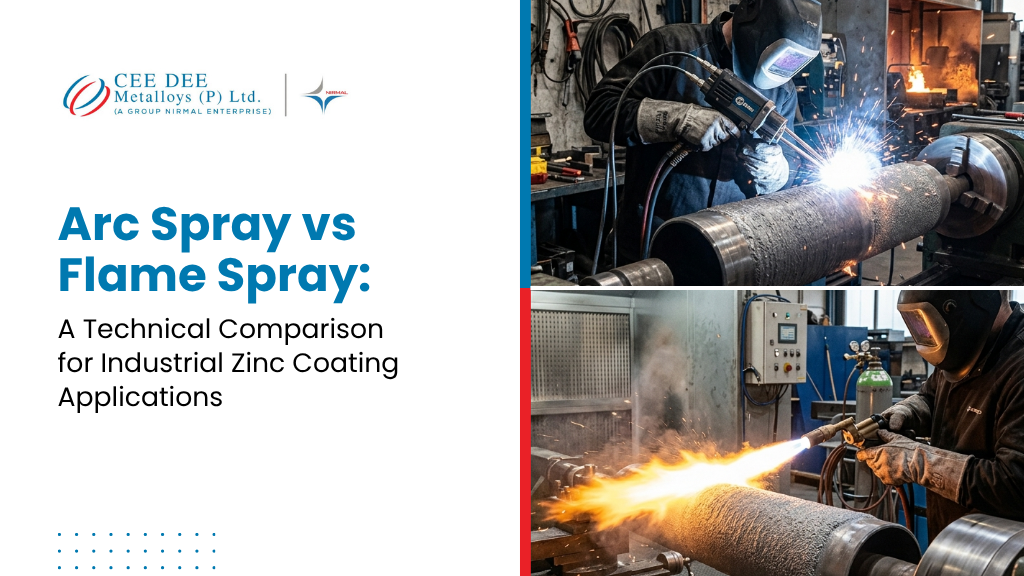
Arc spray produces lower porosity coatings (5-10% vs 10-18% for flame spray) and higher adhesion values, both of which contribute directly to better shielding effectiveness. The lower porosity of arc spray coatings means fewer apertures for electromagnetic wave penetration, and the better adhesion ensures the coating maintains electrical continuity under thermal cycling. For SE requirements above 50 dB, arc spray is the strongly preferred process. The zinc metallizing spray machine systems from CeeDee Metalloys are available in arc spray configurations suitable for EMC coating applications.
Flame Spray for EMC
Flame spray is acceptable for lower SE requirements (below 40 dB) or for applications on substrates or in locations where arc spray equipment cannot be positioned. The higher porosity of flame spray coatings requires more careful sealing to achieve acceptable shielding performance. For in-situ repair of existing shielding coatings in rooms or enclosures where electrical equipment is present and arc spray power cables cannot be safely routed, flame spray provides a viable alternative.
7. Niche and Emerging Shielding Applications
Anechoic Chambers
Electromagnetic anechoic chambers used for antenna testing, radar cross-section measurement, and EMC testing require continuous conductive room shells with SE typically exceeding 80 dB from 30 MHz to 18 GHz or higher. Thermal spray zinc coatings on the chamber walls, applied over concrete or steel construction, provide the continuous conductive shell. The combination of thick zinc coatings (300-500 micrometres) with conductive sealers and RF absorber foam panels provides the combination of shielding and absorption required for a high-performance anechoic chamber.
Smart Building Infrastructure
Modern smart buildings and data centres incorporate shielded rooms, electromagnetic quiet zones, and secure communications facilities that require integral EMC shielding in the building fabric. Thermal spray zinc coating of structural concrete or plasterboard panels during construction provides a durable, maintenance-free shielding solution integrated into the building envelope. This approach is increasingly specified for data centre construction, government secure facilities, and hospital imaging suites.
Electric Vehicle Battery Packs
Electric vehicle (EV) battery pack enclosures require electromagnetic shielding to prevent interference between the high-frequency switching of the battery management system and power electronics and the vehicle’s communication systems. Thermal spray zinc coatings on aluminium battery pack housings provide a lightweight, high-conductivity shielding layer that does not add significant weight to the battery system. The galvanic protection provided by zinc coatings over aluminium also helps prevent crevice corrosion at housing joints and seams.
8. Selection Guide: When to Choose Thermal Spray Zinc for EMC
Thermal spray zinc coatings are not always the optimal EMC shielding solution. The following framework helps engineers assess whether thermal spray zinc is the right choice for a given shielding application and, if so, which coating specification to target.
Thermal Spray Zinc is Well-Suited When:
The substrate is a complex three-dimensional structure that is difficult to shield with sheet metal. When the shielding requirement combines EMC performance with corrosion resistance (outdoor, marine, or industrial environments). When a permanent, non-delaminating coating is needed in preference to conductive paint or foil. When the coating must withstand mechanical abuse, cleaning, or repainting. When the substrate is non-metallic (plastic, composite, concrete) and must be converted to a conductive surface. When in-situ application in an existing building or room is required without demolition.
Alternative Shielding Methods May Be Preferred When:
SE requirements exceed 80 dB (where multi-layer shielding systems or solid metal enclosures are typically required). When the substrate is too thin or fragile to withstand abrasive blasting for surface preparation. When the coating area is extremely small and the overhead of setting up thermal spray equipment cannot be justified. When cost is the sole criterion and conductive paint provides adequate SE for the application.
External Standards
The IEEE 299 standard is the primary reference for measuring shielding effectiveness of enclosures. ASTM D4935 provides a standardised test method for planar material SE. The IEC 61000 series covers electromagnetic compatibility testing. ITU-T K.35 provides guidance on shielding of telecommunications facilities. The NEMA standards for enclosure classification include EMC shielding requirements for industrial enclosures.
9. EMC Standards and Testing Protocols
Electromagnetic shielding performance is verified against a well-established body of international and national standards, each targeting specific application types and frequency ranges.
Shielding Effectiveness Measurement
IEEE 299 (Standard Method for Measuring the Effectiveness of Electromagnetic Shielding Enclosures) is the primary test method for room-sized shielded enclosures, covering frequencies from 9 kHz to 18 GHz. ASTM D4935 provides a coaxial transmission line test fixture method for measuring SE of flat panel materials from 30 MHz to 1.5 GHz. For product-level EMC testing, IEC 61000-4-3 (radiated immunity) and IEC 61000-4-6 (conducted immunity) are the key test standards under the CE marking framework.
Military EMC Testing
MIL-STD-461G is the current US Department of Defense requirement for controlling electromagnetic interference from subsystems and equipment. It specifies radiated and conducted emission and susceptibility tests across frequency ranges from 30 Hz to 40 GHz for different equipment categories. Thermal spray zinc coatings used in defence applications must be qualified as part of the equipment-level MIL-STD-461 testing programme, not tested in isolation as a material.
Key Takeaways
- Thermally sprayed zinc coatings provide electromagnetic shielding through reflection, absorption, and multiple internal reflection mechanisms.
- Shielding effectiveness of 40-70 dB is achievable with 100-300 micrometre arc spray zinc coatings across the 100 MHz to 10 GHz frequency range.
- Arc spray zinc coatings significantly outperform flame spray for EMC applications due to lower porosity, higher coating continuity, and better electrical properties.
- 99.995% SHG purity zinc wire is mandatory for shielding applications to maximise electrical conductivity and minimise impurity-related resistivity increases.
- Zinc-aluminium alloy wire delivers better shielding at frequencies above 1 GHz compared with pure zinc wire, due to its lower coating porosity.
- Conductive sealants over the thermal spray layer can improve SE by 5-15 dB by closing open pores and improving coating continuity.
- Principal application sectors include electronics enclosures, defence systems, MRI facilities, 5G infrastructure, and anechoic chambers.
10. CeeDee Metalloys Serves Industries Across India
- Electronics enclosure manufacturers and OEM fabricators
- Defence electronics systems integrators
- Hospital and medical imaging facility contractors
- 5G and telecom infrastructure builders
- Data centre and secure facility construction specialists
- EMC test laboratory and anechoic chamber builders
11. Related Reading
Frequently Asked Questions
How does a thermally sprayed zinc coating provide electromagnetic shielding?
Thermally sprayed zinc creates a continuous electrically conductive metallic layer on the substrate surface. When electromagnetic waves encounter this conductive layer, three mechanisms attenuate the wave energy: reflection from the conductive surface, absorption within the coating as the wave induces eddy currents, and multiple internal reflections within the coating thickness. The relative contribution of each mechanism depends on the frequency of the electromagnetic field and the electrical conductivity and thickness of the zinc coating.
What shielding effectiveness (SE) can be achieved with thermal spray zinc coatings?
Thermal spray zinc coatings of 100-200 micrometres thickness typically achieve shielding effectiveness of 40-60 dB across the frequency range of 100 MHz to 1 GHz. Increasing coating thickness to 300-400 micrometres can improve SE to 60-70 dB. Performance is highest at lower frequencies where reflection dominates. For very high SE requirements above 80 dB, thermal spray zinc is typically used as a component of a multi-layer shielding system.
Is zinc wire better than aluminium wire for electromagnetic shielding coatings?
At lower frequencies, zinc provides better shielding against magnetic fields than aluminium due to its higher magnetic permeability. At frequencies above 1 GHz, aluminium’s higher electrical conductivity gives it a slight advantage. For broadband shielding, zinc-aluminium alloy wire (ZnAl15) offers a useful compromise. The choice also depends on corrosion environment and coating adhesion requirements specific to the application.
What substrates can be shielded using thermal spray zinc wire coatings?
Thermal spray zinc coatings can be applied to a wide range of substrates: plastic enclosures, composite panels, concrete walls, wood panels, plasterboard, and existing metallic structures. For non-metallic substrates, an adhesion promoter or specialised surface preparation process is required before thermal spray application. Steel and aluminium substrates require standard abrasive blast cleaning to Sa 2.5.
Does the porosity of a thermal spray zinc coating affect its shielding effectiveness?
Yes. Coating porosity creates discontinuities in the conductive layer that act as apertures for electromagnetic wave penetration, reducing shielding effectiveness. Arc spray zinc coatings with lower porosity (5-10%) outperform flame spray coatings with higher porosity (10-18%). Applying a conductive sealant over the thermal spray layer closes open pores and can improve shielding effectiveness by 5-15 dB depending on the frequency range.
What thickness of thermally sprayed zinc is required for EMC shielding?
For general EMC compliance coatings targeting 40-50 dB SE in the 100 MHz to 1 GHz range, 100-150 micrometres is typically sufficient. For higher SE requirements or lower frequency applications, 200-300 micrometres is more appropriate. MRI facility shielding and anechoic chamber applications may require 300-500 micrometres in combination with a conductive topcoat or sealant.
Is thermal spray zinc shielding affected by temperature?
The electrical resistivity of zinc increases with temperature, which reduces shielding effectiveness at elevated operating temperatures. For standard electronics enclosure applications operating at ambient temperatures, this effect is negligible. For applications in high-temperature environments above 150 degrees C, the shielding performance should be verified at the operating temperature, as the SE reduction can become significant at temperatures approaching the zinc melting point.
What international standards govern electromagnetic shielding effectiveness testing?
Key standards include IEEE 299 (Standard Method for Measuring the Effectiveness of Electromagnetic Shielding Enclosures), MIL-STD-461 for defence applications, the IEC 61000-4 series for general EMC testing, and ASTM D4935 for planar material shielding effectiveness measurement. EN 50147 covers anechoic chambers specifically.