10 Lesser-Known Industrial Applications of Zinc Rods
Key Highlights
- Zinc rods have at least 10 significant industrial applications beyond standard thermal spray metallizing.
- Electroplating anode, cathodic protection, zinc-air battery, and water purification are among the less well-known uses.
- The versatility of zinc rods stems from zinc’s unique combination of electrochemical activity, low melting point, and non-toxicity.
- High-purity zinc (SHG or HG grade) is required for most of the lesser-known industrial applications discussed in this article.
- CeeDee Metalloys supplies high-purity zinc rods and zinc wire for the full spectrum of industrial zinc applications across India.
- Understanding the full range of zinc rod applications enables engineers to identify cost-effective zinc-based solutions for diverse corrosion and process challenges.
In This Article
- Overview: Why Zinc Rods Are So Versatile
- How Zinc Rods Serve Multiple Industries
- The 10 Lesser-Known Industrial Applications
- Application 1: Electroplating Anode Material
- Application 2: Cathodic Protection Systems
- Application 3: Zinc-Air Battery Electrodes
- Application 4: Water Purification and Treatment
- Application 5: Die Casting Alloy Preparation
- Application 6: Zinc Brazing and Soldering
- Application 7: Galvanic Testing and Calibration
- Application 8: Marine Hull Sacrificial Anodes
- Application 9: Chemical Manufacturing Processes
- Application 10: Concrete Reinforcement Protection
- CeeDee Metalloys Serves Customers Across India
- Related Reading
- Frequently Asked Questions
Most engineers and procurement professionals associate zinc rods primarily with flame spray metallizing, the process of depositing a protective zinc coating on steel structures. While this remains the highest-volume use of zinc rods in industrial settings, it represents only one dimension of zinc’s remarkable versatility as an industrial material. Zinc’s unique combination of electrochemical properties, low melting point, non-toxicity, and broad compatibility with other materials enables it to serve a surprisingly diverse range of industrial functions.
CeeDee Metalloys supplies high-purity zinc rods and related zinc products including zinc wire, zinc-aluminium wire, and tin-zinc wire to customers across India. This article explores 10 lesser-known industrial applications of zinc rods that demonstrate zinc’s breadth of utility far beyond conventional thermal spray coating. Our quality assurance standards ensure that all zinc rod products meet the purity and dimensional requirements of these diverse applications.
1. Overview: Why Zinc Rods Are So Versatile
Zinc’s industrial versatility derives from several intrinsic material properties that distinguish it from other common metals. Its standard electrode potential of -0.76 V vs. SHE makes it electrochemically active enough to provide sacrificial protection to steel while remaining stable in neutral and mildly alkaline environments. Its melting point of 419 degrees Celsius is low enough for easy casting and thermal spray processing but high enough to be stable under normal industrial service conditions.
Zinc is also non-toxic at typical industrial concentrations, abundant in the earth’s crust, recyclable without degradation of properties, and compatible with a wide range of alloy partners including aluminium, tin, copper, and magnesium. These attributes collectively explain why zinc serves more than 50 distinct industrial process roles beyond its primary use in corrosion protection coatings.
Data Callout: According to the International Zinc Association, global zinc consumption exceeds 14 million metric tonnes annually. While galvanizing accounts for approximately 50% of consumption, the remaining 50% is distributed across die casting, brass production, rolled zinc products, zinc chemicals, and numerous specialised industrial applications.
2. How Zinc Rods Serve Multiple Industries
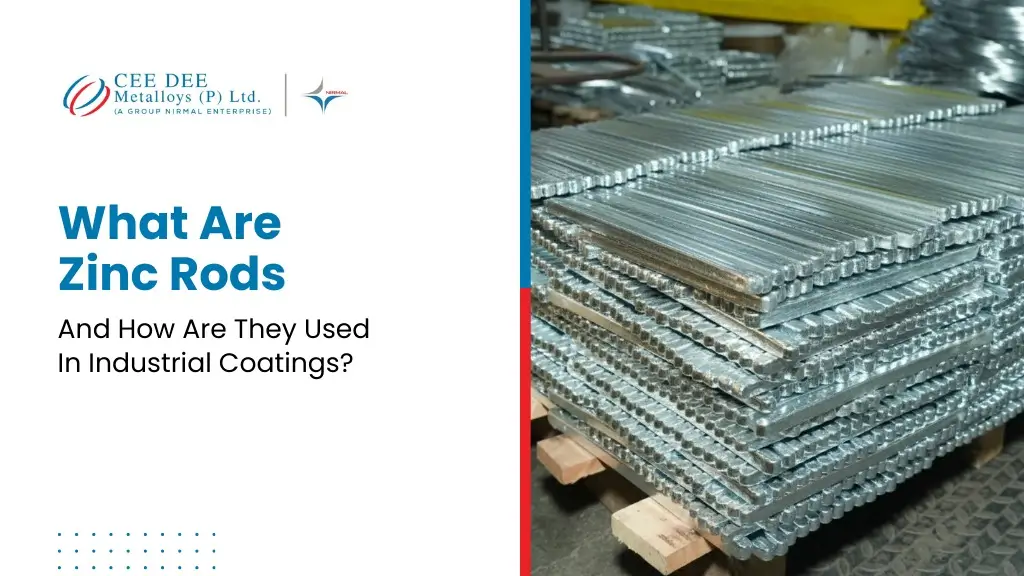
The form factor of the zinc rod, a solid cylinder of precise dimensions manufactured from high-purity zinc, is optimised for handling and processing in industrial equipment. Rod-fed spray guns, electroplating anodes, cathodic protection fixtures, and brazing torch feeds all benefit from the dimensional consistency and predictable feed characteristics of a well-manufactured zinc rod.
High-purity grades (SHG at 99.99% or HG at 99.95%) ensure that trace element contamination does not interfere with process chemistry in plating baths or battery electrolytes, and that the electrochemical behaviour of the rod is consistent with the design parameters of cathodic protection systems. CeeDee Metalloys manufactures zinc rods to exacting purity and dimensional standards, supporting the full range of applications described in this article.
📖 Also Read: Zinc Rods Uses in Industrial Coatings
3. The 10 Lesser-Known Industrial Applications
The following sections describe 10 industrial applications of zinc rods that are less frequently discussed than thermal spray metallizing but represent significant and growing markets for high-purity zinc rod products.
4. Application 1: Electroplating Anode Material
Zinc electroplating is one of the most widely used industrial surface finishing processes, depositing a thin, adherent zinc layer on steel components to provide corrosion protection, lubricity, and a base for subsequent paint or conversion coating. In zinc electroplating baths, high-purity zinc rods serve as soluble anode material that dissolves at the anode during the plating process to continuously replenish the zinc ion concentration in the electrolyte.
The purity of the zinc anode rod is critical to plating bath chemistry. Trace impurities such as lead, cadmium, iron, and copper at even parts-per-million concentrations can degrade plating quality, causing dull, burnt, or pitted deposits. Special High Grade (SHG) zinc rods at 99.99% purity are specified for most barrel and rack electroplating operations. The dimensional consistency of the rod must also be maintained to ensure predictable anode current distribution and uniform bath dissolution.
📖 Also Read: Use of Zinc in Electronics
5. Application 2: Cathodic Protection Systems
Cathodic protection (CP) is an electrochemical technique used to control the corrosion of metal structures by making them the cathode of an electrochemical cell. In galvanic (sacrificial anode) cathodic protection systems, zinc rods or cast zinc anode shapes are connected to the steel structure to be protected. The zinc, being electrochemically less noble, corrodes preferentially, delivering protective current to the steel and suppressing its corrosion rate to near zero.
Applications for zinc sacrificial anodes include buried steel pipelines, underground storage tanks, jetty and wharf piles, ship hulls, offshore platform structural members, and reinforced concrete in marine environments. The performance of a zinc sacrificial anode depends critically on the alloy purity and composition: high-purity zinc anodes maintain a consistent open-circuit potential and deliver reliable protective current over their designed service life.
Zinc Anode Standards
Zinc sacrificial anodes for cathodic protection must conform to standards including MIL-A-18001K (military specification for zinc anodes), ASTM B418 (zinc anodes for marine use), and DNVGL-RP-B401 (offshore cathodic protection design). Purity and alloy composition limits specified in these standards must be met by the zinc rod manufacturer. Learn more about CeeDee Metalloys’ application expertise in cathodic protection materials.
6. Application 3: Zinc-Air Battery Electrodes
Zinc-air batteries represent one of the most promising energy storage technologies for grid-scale applications and electric vehicles, offering high theoretical energy density at relatively low material cost. In a zinc-air cell, the zinc anode is electrochemically oxidised during discharge, releasing electrons that flow through the external circuit to the air cathode where oxygen from the atmosphere is reduced.
High-purity zinc is required for battery-grade anode applications to minimise parasitic self-discharge reactions caused by impurity corrosion. The development of rechargeable zinc-air batteries for energy storage is an active area of research, with pilot projects demonstrating grid-scale storage using zinc anode rods and plates that are mechanically replaced or electrochemically recharged during the charging cycle.
7. Application 4: Water Purification and Treatment
Zinc has well-documented anti-microbial properties at concentrations above approximately 0.1 mg/L in water. Electrochemical water treatment systems utilising zinc anodes exploit this property to control biological fouling in cooling water systems, industrial process water, and some potable water treatment applications. As the zinc anode dissolves slowly, it releases zinc ions into the water at concentrations sufficient to inhibit microbial growth without exceeding regulatory limits for zinc in treated water.
Zinc rods and zinc-copper alloy anodes are used in electrolytic water treatment systems as an alternative to chemical biocide dosing, offering a lower environmental impact approach to cooling tower and process water management. Bio-zinc products from CeeDee Metalloys are specifically designed for water treatment and biological control applications.
High-Purity Zinc Rods for Every Industrial Application
CeeDee Metalloys supplies SHG and HG grade zinc rods for metallizing, electroplating, cathodic protection, and specialised industrial applications across India. All products are supplied with material test certificates confirming purity and dimensional compliance.
View Zinc Products8. Application 5: Die Casting Alloy Preparation
Die casting is one of the largest industrial consumers of zinc metal globally. Zinc die casting alloys (Zamak alloys) containing zinc as the primary metal with additions of aluminium, magnesium, and copper are used to produce precision net-shape components for automotive, consumer electronics, appliance, and hardware industries. High-purity zinc rods serve as the primary feedstock for melting and preparing Zamak die casting alloy charges.
The quality of the zinc rod feedstock directly influences the quality of the die casting alloy: impurities that cause embrittlement, dimensional instability, or surface defects in die cast parts must be controlled at the zinc rod level. Alloy composition is typically verified by optical emission spectrometry on melted samples before casting commences.
9. Application 6: Zinc Brazing and Soldering
Zinc-based brazing rods and zinc-aluminium brazing alloys are used for joining aluminium and aluminium alloy components. Zinc-aluminium brazing alloys (typically Zn-12Al) have liquidus temperatures in the range of 380 to 420 degrees Celsius, enabling flux-free brazing of aluminium heat exchangers, refrigeration tubing, and air conditioning components at temperatures below the melting point of the aluminium base metal.
This application is particularly significant in the HVAC and automotive thermal management industries, where aluminium heat exchangers must be joined reliably at high production rates without the complications of flux removal associated with conventional brazing processes. The zinc content of the brazing alloy provides corrosion protection at the joint interface after solidification.
📖 Also Read: Zinc Aluminium Wires: Metal Protection Benefits
10. Application 7: Galvanic Testing and Calibration
Zinc rods are used as reference electrodes and standard test specimens in electrochemical testing laboratories. The stable and well-characterised electrochemical potential of high-purity zinc in standard electrolytes makes it a reliable reference material for calibrating corrosion testing equipment, constructing galvanic series measurements, and validating cathodic protection system designs.
Research laboratories, coating specification bodies, and quality assurance departments in marine and oil and gas industries regularly consume high-purity zinc rods for electrochemical testing, ensuring that their measurement systems are correctly calibrated and producing reliable data for engineering decisions.
11. Application 8: Marine Hull Sacrificial Anodes
Ship hulls, propeller shafts, rudders, and other submerged steel and aluminium components on marine vessels are protected from seawater corrosion using zinc sacrificial anodes. The anodes are attached to the hull surface or shaft and corrode preferentially to protect the more noble structural metals. Hull zinc anodes must be replaced at each dry-docking interval, typically every two to five years depending on vessel type and trading pattern.
Zinc is preferred over aluminium and magnesium anodes in many marine applications because its electrochemical potential in seawater is well matched to the protection requirement for steel and propeller bronze alloys without over-protecting (causing hydrogen embrittlement of high-strength steel components). Zinc anodes for marine use must conform to ASTM B418 Type I composition requirements.
12. Application 9: Chemical Manufacturing Processes
Zinc metal plays a direct role in several chemical manufacturing processes. Zinc rods are used as reductants in hydrometallurgical processes for recovering precious metals (gold, silver, platinum group metals) from leach solutions by cementation, where zinc dissolves and displaces the target metal from solution. High-purity zinc is required in these processes to avoid contamination of the recovered metal product.
Zinc rods are also used in the manufacture of zinc chemicals including zinc sulphate, zinc chloride, zinc oxide, and zinc acetate, which have applications in agriculture, pharmaceuticals, rubber manufacturing, and specialty chemical sectors. The purity of the zinc rod feedstock determines the purity of the derived zinc chemical products.
13. Application 10: Concrete Reinforcement Protection
Thermal spray zinc coating applied directly to steel reinforcing bars before casting in concrete provides cathodic protection that dramatically reduces the rate of corrosion-induced concrete spalling over the design life of the structure. This application, discussed in more detail in our article on extending structural lifespan, uses zinc rods or zinc wire as the feedstock for the thermal spray process applied to the rebar before it is placed in the formwork.
In existing structures, zinc overlay systems applied to the concrete surface above corroding rebar provide cathodic protection by supplying galvanic current through the moist concrete cover layer to the steel reinforcement. This technique extends the service life of deteriorating coastal and de-iced bridge structures by decades, deferring expensive structural repairs.
💡
The ten applications described in this article represent only a selection of zinc’s industrial uses. If you have an application involving zinc metal that is not covered here, contact CeeDee Metalloys to discuss how our zinc rod and wire products can be adapted to your specific requirements.
Key Takeaways
- Zinc rods serve at least 10 significant industrial applications beyond thermal spray metallizing for structural coatings.
- Electroplating anodes, cathodic protection sacrificial anodes, and die casting alloy preparation are among the highest-volume lesser-known applications.
- High-purity SHG or HG grade zinc rods are required for most specialised applications to prevent process chemistry contamination.
- Zinc-air battery technology represents a growing future market for high-purity zinc anode material in energy storage applications.
- Zinc’s non-toxic nature enables its use in food contact, water treatment, and pharmaceutical applications where other metals cannot be used.
- CeeDee Metalloys supplies zinc rods across India with material test certificates for all purity grades and application requirements.
14. CeeDee Metalloys Serves Customers Across India
CeeDee Metalloys supplies zinc rods, zinc wire, and metallizing consumables for all the applications described in this article. Our distribution network reaches major industrial centres across India.
Zinc Wire and Rod Suppliers – North India
Zinc Aluminium Wire Suppliers
Metallizing Spray Machine Suppliers
15. Related Reading
Articles
Products and Company
Zinc Rods for Every Industrial Application
Whatever your industrial zinc application, CeeDee Metalloys has the purity grade, form factor, and technical expertise to support your project. From thermal spray metallizing to cathodic protection, electroplating, and beyond, trust CeeDee Metalloys for reliable zinc supply across India.
Contact CeeDee MetalloysExplore our range at ceedeemetalloys.com | Our Services
16. Frequently Asked Questions
What are the main industrial applications of zinc rods beyond thermal spray metallizing?
Beyond thermal spray metallizing, zinc rods are used in electroplating as anode material, cathodic protection of pipelines and tanks, zinc-air battery electrodes, water purification processes, die casting alloy preparation, brazing and soldering, galvanic testing, and as sacrificial anodes in marine hull protection.
How are zinc rods used in cathodic protection?
Zinc rods are connected to buried steel pipelines, underground tanks, or marine structures as sacrificial anodes. Being electrochemically less noble than steel, the zinc rod dissolves preferentially, supplying protective galvanic current that suppresses corrosion of the steel structure.
Can zinc rods be used in electroplating processes?
Yes. High-purity zinc rods are used as soluble anode material in zinc electroplating baths. The rods dissolve at a controlled rate to replenish zinc ions consumed during the plating process, maintaining consistent bath chemistry and plating quality.
What role does zinc play in water purification?
Zinc rods are used in some water purification and water treatment systems as part of electrochemical water treatment processes. Bio-zinc products from CeeDee Metalloys are specifically designed for water treatment and biological control applications.
Are zinc rods used in the automotive industry?
Yes. The automotive industry uses zinc rods as anode material in zinc electroplating of automotive components, as feedstock in die casting alloy preparation, and as sacrificial anodes in automotive cooling system corrosion protection.
What is the role of zinc rods in zinc-air batteries?
In zinc-air batteries and fuel cells, high-purity zinc rods or granules serve as the anode material that is electrochemically oxidised during discharge to generate electrical current. Zinc-air battery technology is being developed for grid energy storage and electric vehicle applications.
Can zinc rods be used for brazing and soldering?
Zinc-based brazing rods and zinc-aluminium brazing alloys are used for joining aluminium and aluminium alloy components without flux in some processes. Zinc’s low melting point and good wetting characteristics on aluminium make it suitable for low-temperature brazing applications.
Where can I purchase zinc rods for industrial applications in India?
CeeDee Metalloys manufactures and supplies zinc rods for thermal spray, electroplating, cathodic protection, and other industrial applications across India. Visit ceedeemetalloys.com for contact details and product information.